
Free printable migraine diary (PDF), with a filled-in example
Print a one-month migraine diary on A4 or US Letter. See a filled-in example, then count migraine days and medication days for your appointment.
The short answer
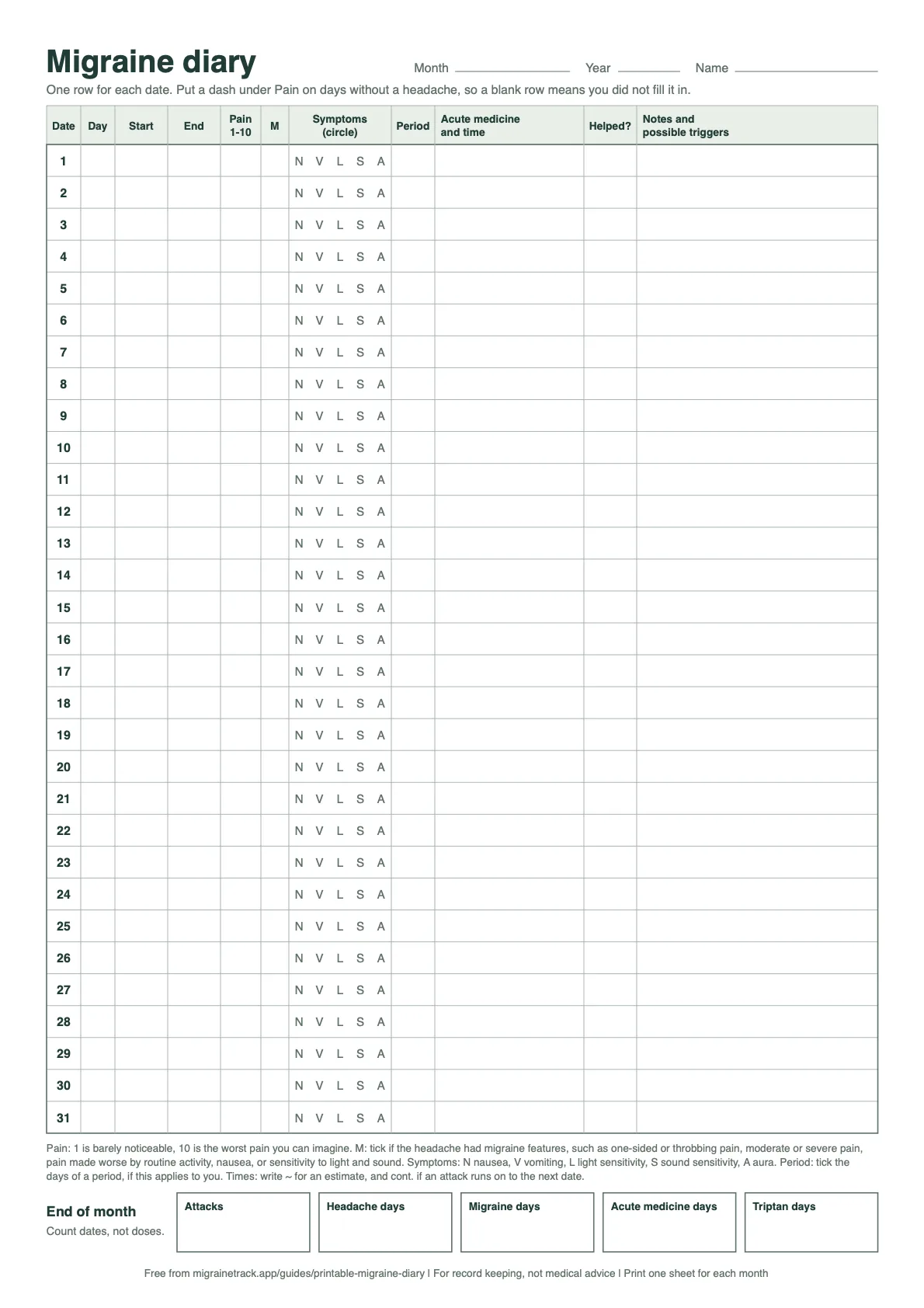
Download a free one-page migraine diary for a month, on A4 or US Letter. There is nothing to sign up for. Print one sheet for each month, fill in a row for each date with a headache, and put a dash on the days without one.
At the end of the month, count your attacks, then count dates, not doses: headache days, migraine days and days with acute medicine. NICE suggests at least 8 weeks of records when a diary is used to help with diagnosis, so print 2 or 3 sheets to start with.
Download the diary
The A4 and US Letter PDFs hold the same one-page sheet, so choose the size your printer uses. A4 is the usual size outside North America, and US Letter is the usual size in the US and Canada. The sheet prints well in black and white.
If your clinic gives you its own diary, use that one. The Migraine Trust, a UK charity, also offers a monthly headache diary in Word and PDF, and Migraine Canada has templates covering 2, 3 and 5 months.
What goes in each column
The columns cover the details NICE lists for a headache diary: how often headaches happen, how long they last and how severe they are, other symptoms, medicines, possible triggers and any link with periods. On a bad day, the times and pain are enough. You can fill in the rest when you feel better.
| Column | What to write | Why it helps |
|---|---|---|
| Date and Day | The date is printed. Add the day of the week: M, T, W and so on. | Shows whether attacks gather on certain days, as in our post on weekend migraines. |
| Start and End | When the headache began and stopped. Write ~ for an estimate, and “cont.” if it runs on to the next date. | Shows how long attacks last. Our guide to timing an attack covers sleep and pain that comes back. |
| Pain | Your worst pain that day from 1 to 10, where 10 is the worst pain you can imagine. | Shows how severe headaches are. Use the same scale each time, and include mild days. |
| M (migraine features) | A tick if the headache had migraine features, such as one-sided or throbbing pain, nausea, or sensitivity to light and sound. | Separates migraine days from other headache days. |
| Symptoms | Circle N for nausea, V for vomiting, L for light sensitivity, S for sound sensitivity and A for aura. | Records what came with the pain, which your clinician may ask about. |
| Period | A tick on the days of a period, if this applies to you. | Lets you compare attacks with your cycle. See tracking migraines around your period. |
| Acute medicine and time | The name, the amount and the time of anything you took to relieve the headache, including medicines you bought yourself. | This is where medicine days are counted from. It records what you took, not what you should take. |
| Helped? | Yes, some or no. | Gives you and your clinician something specific to talk about. |
| Notes and possible triggers | What you noticed, a second headache on the same date, or time off work. | “Slept less than usual” is an observation. Our guide to what to record explains why that is more useful than a conclusion. |
A filled-in example
A filled-in sheet is mostly dashes, because the sheet records the whole month and not only the bad days. This is a fictional September with four attacks, the same month as in our guide to headache days vs migraine days.
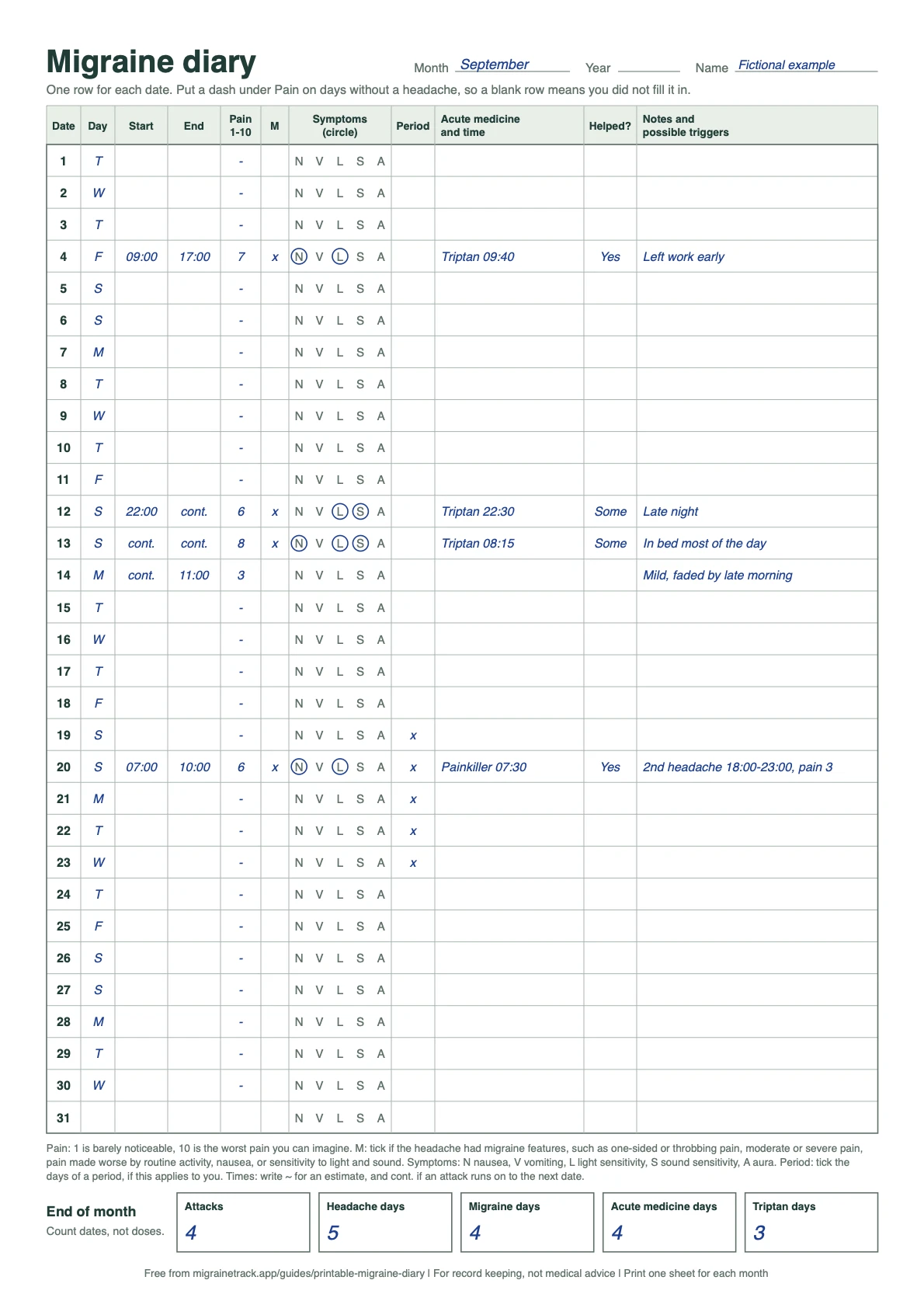
The same rows as text:
| Date | Times | Pain | M | Symptoms | Acute medicine | Helped? | Notes |
|---|---|---|---|---|---|---|---|
| 4 Sept | 09:00–17:00 | 7 | Yes | Nausea, light | Triptan 09:40 | Yes | Left work early |
| 12 Sept | 22:00, cont. | 6 | Yes | Light, sound | Triptan 22:30 | Some | Late night |
| 13 Sept | All day, cont. | 8 | Yes | Nausea, light, sound | Triptan 08:15 | Some | In bed most of the day |
| 14 Sept | Until 11:00 | 3 | No | None | None | – | Mild, faded by late morning |
| 20 Sept | 07:00–10:00 | 6 | Yes | Nausea, light | Painkiller 07:30 | Yes | Second headache 18:00–23:00, pain 3 |
The attack that began at 22:00 on 12 September ended at 11:00 on 14 September, so it fills three rows. The two separate headaches on 20 September share one row, with the second one in the notes.
Count your month
Most of the month’s totals come from counting rows, not tablets. The fictional September adds up like this:
- Attacks
- 4
- Headache days
- 5
- Migraine days
- 4
- Acute medicine days
- 4
- Triptan days
- 3
- Attacks. Count each separate attack once, however many rows it fills. The attack from 12 to 14 September is one attack. The two headaches on 20 September count as two here. ICHD-3 suggests that diaries treat attacks as separate only when at least 48 hours without headache lie between them, which would make them one and the month 3 attacks. Our guide to timing an attack explains that rule. Whichever you use, keep to it.
- Headache days. Count every row with a headache, however mild: 4, 12, 13, 14 and 20 September make 5.
- Migraine days. Count the rows with a tick under M. The mild headache on 14 September had no migraine features, so it is a headache day but not a migraine day.
- Acute medicine days. Count every row with acute medicine. Two doses on one date count once.
- Triptan days. Count these separately, because the headache classification ICHD-3 uses different day counts for triptans and simple painkillers. Those counts are diagnostic criteria, not safe limits.
Exact definitions vary, so if your clinician counts differently, use their rule. Our guides to headache days vs migraine days and triptan and painkiller days explain what these numbers are used for.
How many sheets to print
For a first appointment about headaches, print 2 sheets, or 3 if you are starting part-way through a month. NICE, which advises the NHS in England, says a headache diary used to help with diagnosis should record headaches, symptoms, medicines, possible triggers and any link with periods “for a minimum of 8 weeks”.
Some questions take longer, such as whether migraine has become chronic or whether a preventive treatment is working. Our guide to how long to keep a headache diary goes through them one by one, and our appointment guide covers what else to bring.
Paper or an app?
Paper and an app can hold the same details, so the better choice is the one you will keep using.
- Paper needs no phone, account or battery, and it is easy to hand over at an appointment. You add up the totals yourself, and the sheet has to be with you when you need it.
- Migraine Tracker for iPhone and Apple Watch keeps each attack’s times, pain, symptoms, suspected triggers, medication entries and notes together. Reports adds up Headache Days and Meds Days for the last 7 days. With Premium, you can also see 30 or 90 days and create a PDF report.
- The counts can differ. Migraine Tracker counts a Headache Day on the date an attack starts, so a long attack counts once. For the fictional September, it would show 3 Headache Days where the paper sheet shows 5.
When to talk to someone
- The NHS says to see a GP if “your migraine attacks are severe or getting worse, or lasting longer than usual” or if “you have migraine attacks more than once a week”. You do not need to finish the diary first.
- The NHS says to “ask for an urgent GP appointment or get help from NHS 111” if you have a migraine attack and “it’s lasted longer than 72 hours”. Outside the UK, contact your local urgent care service.
- The NHS says to call 999 if you “have a headache that came on suddenly and is extremely painful”. Elsewhere, call your local emergency number.
Information from the NHS website, as at 061126: Migraine.
Sources
- NICE CG150: Headaches in over 12s, recommendations (last updated 3 June 2025)
- ICHD-3: 1.1 Migraine without aura
- ICHD-3: 8.2 Medication-overuse headache
- The Migraine Trust: Keeping a headache diary
- Migraine Canada: Printable migraine diary templates
- NHS: Migraine
Sources checked on 6 November 2026. The filled-in example uses fictional data.
Diary fields checked against NICE guidance on 6 November 2026. App details checked against Migraine Tracker 1.1.0 on 6 November 2026. The filled-in example uses fictional data and is not a suggested treatment. This guide explains record keeping, not diagnosis or treatment. The sources explain general principles and do not endorse Migraine Tracker.