
How long should you keep a headache diary?
NICE suggests at least 8 weeks for a diagnosis, and some questions need 3 months or more. How long to keep a headache diary, situation by situation.
The short answer
For a first appointment about headaches, keep a diary for at least 8 weeks. That is the minimum in the guideline from NICE, which advises the NHS in England.
Some questions need longer. Whether migraine has become chronic, or whether medicine is being used too often, is judged over more than 3 months. Whether a preventive treatment works is usually judged after 2 to 6 months, depending on the treatment. NICE also suggests using a diary to check how well treatment works, so a lighter diary is worth keeping after that.
Why 8 weeks
NICE says: “Consider using a headache diary to aid the diagnosis of primary headaches.” If one is used, it should cover “a minimum of 8 weeks” and record:
- how often headaches happen, how long they last and how severe they are;
- any symptoms that come with them;
- all prescribed and over-the-counter medicines taken to relieve them;
- possible triggers;
- how headaches relate to periods.
Other services ask for less. The HSE in Ireland suggests “at least 4 weeks”, and the UK’s National Migraine Centre asks for “a month (or as long as you can before your appointment)”. A month can be enough to describe frequent headaches. Eight weeks gives a fairer picture when attacks are less frequent or vary from month to month.
A diary also beats memory. In a 2020 study of 182 people with migraine, participants recorded an average of 13.7 headache days per four weeks in a daily diary, but recalled only 11.1 when asked at the end of the same period. Their recall was lower in all four periods. The two counts were closer when only headaches lasting 8 hours or more were included, which suggests that short headaches were the ones forgotten. The American Migraine Foundation puts it simply: “Many people underestimate the number of days they have a headache.” Our guide to what to record in a migraine diary covers what each entry needs, and our printable migraine diary gives you a sheet for each month.
How long for each question
The right length depends on what you and your clinician want to find out.
| Question | How long | Why |
|---|---|---|
| A first appointment about headaches | At least 8 weeks | NICE’s minimum for a diary used for diagnosis. |
| Has migraine become chronic? | More than 3 months | ICHD-3 defines chronic migraine as headache on 15 or more days a month for more than 3 months, with migraine features on at least 8 of those days. See headache days vs migraine days. |
| Am I taking acute medicine too often? | More than 3 months, then ongoing | Medication overuse headache is defined by regular overuse for more than 3 months. See how to count medication days. |
| Are attacks linked to my periods? | At least 2 cycles, ideally 3 | NICE asks for a diary over at least 2 menstrual cycles. Both NICE and ICHD-3 look for attacks around the start of a period in at least 2 out of 3 cycles. |
| Before starting a preventive treatment | The weeks before you start | Benefit is judged against your headache days before treatment, so the diary you already keep becomes the starting point. |
| Is a preventive treatment working? | At least 8 weeks at the target dose for tablets; at least 3 months for monthly injections; at least 6 months for treatments given every 3 months, such as Botox (see what your diary needs to show for Botox) | American Headache Society guidance on trial length. NICE reviews CGRP antibody treatment after 12 weeks and Botox after 2 treatment cycles. |
| Is an acute medicine working? | At least 3 treated attacks | American Headache Society guidance: “at least three attacks should be treated” before judging an acute treatment. |
The row on starting a preventive is a practical point, not a guideline rule. The other rows summarise the cited guidance. Treatment decisions belong to you and your clinician.
One month rarely settles a question about frequency, because monthly counts swing. In a US study that checked headache days every three months, 386 of 526 people (73%) who had chronic migraine at the start fell below the chronic range at least once during the following year.
A worked example
Here is a fictional example. You book a GP appointment eight weeks away and start a diary the same day. By the appointment, it shows 18 headache days in eight weeks, about 9 every four weeks.
Your GP suggests a preventive treatment and asks you to keep the diary going. Twelve weeks after you start the treatment, your diary shows about 4 headache days every four weeks. That is a fall of more than half from your first eight weeks, which is one of the measures of success in American Headache Society guidance.
Without the first eight weeks, there would be nothing to compare with. Whether to continue, change or stop a treatment is a decision for you and your clinician.
Keep it going
- Log every headache day, including mild ones. Short and mild headaches are the ones memory drops, and every headache day counts towards the totals your clinician uses.
- Log on the day. An entry made the same day is more reliable than one made at the end of the week.
- Use a reminder. In a 2026 study of 4,236 people using a German headache diary app, entries fell by 11% during two weeks when the app’s daily reminders failed. Migraine Tracker does not send daily reminders, so a repeating reminder in your iPhone’s Reminders app can do the job.
- Fill gaps honestly. If you missed a day, add the attack later with your best estimate of the time, and say in the note that it is an estimate.
- Keep entries short. The time, pain level and any medicine are enough on a bad day. You can add symptoms, triggers and notes when you feel better.
How Migraine Tracker helps
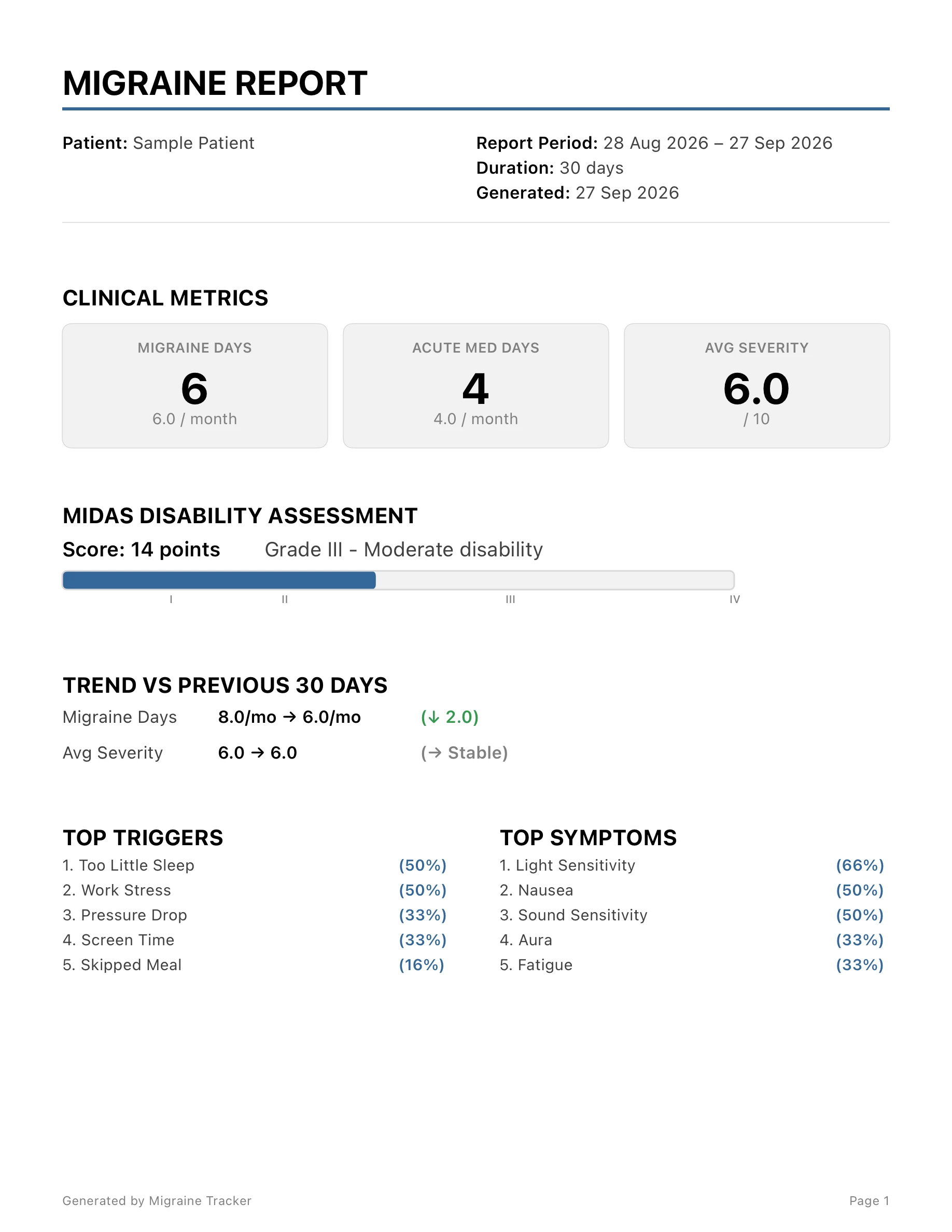
- Reports. Headache Days and Meds Days for the last 7 days. With Premium, you can also choose 30 or 90 days.
- PDF reports. With Premium, a PDF can cover 30 days, 90 days, 6 months or 1 year. Page 1 compares Migraine Days per month and average severity with the previous period of the same length. Without earlier records, it shows “New Baseline”. Page 2 has a calendar and a table for each calendar month.
- Longer questions. For questions that look at more than 3 months, such as chronic migraine or medicine days, a 6-month PDF shows each calendar month separately. The PDF report guide shows the steps.
- MIDAS. With Premium, the MIDAS questionnaire asks about the last 3 months and can be repeated after 3 months.
- Attacks you missed. You can add or edit a past attack in History, with your own start and end times.
- Days without a headache. The app records attacks, so a day without an entry is not proof that you had no headache. Keep logging regularly so an empty day really means a headache-free day.
When not to wait for your diary
- A diary supports an appointment; it does not need to be finished first. The NHS says to see a GP if “your migraine attacks are severe or getting worse, or lasting longer than usual” or if “you have migraine attacks more than once a week”.
- The NHS says to “ask for an urgent GP appointment or get help from NHS 111” if you have a migraine attack and “it’s lasted longer than 72 hours”. Outside the UK, contact your local urgent care service.
- The NHS says to call 999 if you “have a headache that came on suddenly and is extremely painful”. Elsewhere, call your local emergency number.
Information from the NHS website, as at 061126: Migraine.
Sources
- NICE CG150: Headaches in over 12s, recommendations (last updated 3 June 2025)
- ICHD-3: 1.3 Chronic migraine
- ICHD-3: 8.2 Medication-overuse headache
- ICHD-3: A1.1.2 Menstrually related migraine without aura
- Ailani et al. The American Headache Society consensus statement: update on integrating new migraine treatments into clinical practice. Headache, 2021
- Miller et al. Comparing prospective headache diary and retrospective four-week headache questionnaire over 20 weeks. Cephalalgia, 2020
- Serrano et al. Fluctuations in episodic and chronic migraine status over the course of 1 year: implications for diagnosis, treatment and clinical trial design. The Journal of Headache and Pain, 2017
- Ruscheweyh et al. Daily reminders increase adherence to an electronic headache diary (DMKG-App). JMIR mHealth and uHealth, 2026
- American Migraine Foundation: What is chronic migraine?
- HSE: Diagnosing migraine
- National Migraine Centre: Headache diary
- NHS: Migraine
Sources checked on 14 October 2026. The worked example and the sample PDF use fictional demonstration data.
Diary lengths checked against NICE, ICHD-3 and American Headache Society guidance on 14 October 2026. App details checked against Migraine Tracker 1.0.9. The worked example and the sample PDF use fictional demonstration data. This guide explains record keeping, not diagnosis or treatment. The sources explain general principles and do not endorse Migraine Tracker.