
How long does a migraine last? How to time an attack
Untreated, a migraine attack lasts 4 to 72 hours in adults. When an attack starts and ends in your diary, and how to count sleep and pain that comes back.
The short answer
Untreated, or when treatment does not work, a migraine attack without aura lasts 4 to 72 hours in adults and 2 to 72 hours in under-18s, according to ICHD-3, the headache classification. In a Dutch e-diary study of 500 women, the median attack lasted about 16 hours away from a period and 20 hours around one.
Time an attack from when the headache starts until it has gone. If you fall asleep and wake up without it, the attack ended when you woke up. If the pain comes back within 48 hours, ICHD-3 suggests keeping it in the same diary entry; whichever rule you use, keep to it.
An attack lasting more than 72 hours needs urgent advice: see when not to wait.
How long a migraine attack lasts
A migraine attack lasts 4 to 72 hours when it is untreated or treatment does not work, according to the criteria for migraine without aura in the International Classification of Headache Disorders (ICHD-3). The range describes the headache itself. For children and teenagers under 18, ICHD-3 gives 2 to 72 hours.
The NHS says: “Migraine attacks usually last between 4 hours and 3 days, with early symptoms (such as feeling very tired) starting hours or up to 2 days before the head pain starts and finishing after the headache stops.” (Information from the NHS website, as at 201026: Migraine.)
Typical attacks fall well inside that range. In a 2021 Dutch study, 500 women kept a daily electronic diary. The median attack lasted 16.1 hours away from a period and 20.0 hours around one, when pain that came back within 24 hours counted as the same attack. With a 48-hour rule instead, the medians were 22.7 and 35.4 hours, which shows how much the counting rule matters. It is one group of women, so your own attacks may be shorter or longer.
A treated attack can be shorter than 4 hours, because the 4-hour minimum applies only to attacks that are untreated or not helped by treatment. Your diary is what shows how long your attacks usually last.
The attack timeline: which part you time
An attack can have up to four phases, and the 4 to 72 hours describe the headache phase. Not everyone has every phase, or has them in every attack.
| Phase | How long | What to write down |
|---|---|---|
| Prodrome, the warning signs | Up to 48 hours before the pain, or before the aura | When you first noticed it, in a note |
| Aura, if you have it | Each aura symptom usually lasts 5 to 60 minutes, and the headache often follows within 60 minutes | When the aura started and ended |
| Headache | 4 to 72 hours, untreated | The start and end of the attack |
| Postdrome, the “migraine hangover” | Up to 48 hours after the pain has gone | When you felt back to normal, in a note |
For aura, the NHS says: “Aura symptoms should not last for longer than 1 hour.” (Information from the NHS website, as at 201026: Migraine.) An aura that lasts longer is on the list in when not to wait.
In ICHD-3, only the headache sets the attack’s duration. The prodrome and the migraine hangover, or postdrome, are worth noting, but they do not make the attack longer.
When an attack starts and ends
An attack starts when the headache starts and ends when the headache has gone: ICHD-3 measures its duration from onset to termination.
- Start: the time the headache began, even if you record it later. If you woke up with it, record the time you woke and note that you woke up with it; the International Headache Society’s 2020 trial guidelines also take the time you woke as the start. Warning signs before the pain go in a note; they are not the start.
- End: the time the headache has gone. ICHD-3 notes that a mild, non-throbbing headache without other symptoms can linger after a migraine attack, and that it is not part of the attack. So it does not move the end time; write it in a note instead.
- Estimates: if you are not sure of a time, record your best estimate and say so in a note. The guide to what to record lists what else each entry needs.
Tiredness or fog after the pain has gone does not make the attack longer either. The post on the migraine hangover explains how to record it.
If you fall asleep during an attack
If you fall asleep during an attack and wake up without the headache, ICHD-3 counts the attack until you woke up, not until you fell asleep. If you wake up still in pain, the attack has not ended.
Research can count it differently. When clinical trials count migraine days, the International Headache Society’s 2020 guidelines treat an attack you slept off as ending when you fell asleep, and when they total hours of pain, they count half of the hours you slept.
For a personal diary, the ICHD-3 rule is the simplest: end the attack when you woke up, and note when you fell asleep, so either count is possible later. If you stopped the entry when you went to bed, correct the end to the time you woke and add a note, for example “asleep 22:30, woke without pain 06:45”.
If the pain comes back
Pain that comes back within 48 hours may be the same attack or a new one. When it returns after medicine had relieved it, ICHD-3 says it may be a relapse or a new attack, and that judgement is needed to tell them apart.
For diary entries, ICHD-3 suggests a practical rule: count attacks as separate only when at least 48 hours without headache lie between them. Research uses similar rules. In trials of preventive treatment, the International Headache Society’s 2020 guidelines count pain that returns within 48 hours, after sleep, a let-up or successful treatment, as the same attack. The 2021 Dutch diary study used 24 hours, and checked 48 hours too.
- Choose one rule, with your clinician if you can, and write it in a note.
- Keep to it. Either keep one entry from the first start to the last end, or keep two entries and note the gap between them.
- Know what it changes. One long entry and two short ones give different attack counts, durations and day counts.
How long is too long?
An attack that lasts more than 72 hours is outside the usual range for migraine. ICHD-3 calls a debilitating attack that has not let up for more than 72 hours status migrainosus, and it still counts the attack as continuous through pain-free gaps of up to 12 hours due to medicine or sleep. So an attack with short breaks can still count as lasting more than 72 hours.
Don’t wait for 72 hours if something feels wrong. The NHS advice for an attack that has lasted longer than 72 hours, and the signs that need help straight away, are in when not to wait.
A timed history also shows whether an attack is lasting longer than usual for you. A headache on most days is a different question, about days rather than duration: see headache days vs migraine days.
A worked example
One fictional episode can give three different records. On Tuesday 13 October, yawning started at about 11:00 and the headache at 14:10. Medicine was logged at 15:00, and at 22:30 the person fell asleep, still in pain. They woke without the headache at 06:45 on Wednesday, but it came back at 13:20, with light sensitivity, and was gone by 19:00.
| How it was recorded | Entries and durations | Avg Duration |
|---|---|---|
| Stopped at bedtime; the return logged as a new attack | 2: 8 hr 20 min and 5 hr 40 min | 7 hr 0 min |
| Ended at waking, as in ICHD-3; the return logged as a new attack | 2: 16 hr 35 min and 5 hr 40 min | 11 hr 7 min |
| The return within 48 hours kept in the same attack, with the gap | 1: 28 hr 50 min | 28 hr 50 min |
The yawning goes in a note, so every way starts at 14:10. Recorded the first way, the first attack looks 8 hours 15 minutes shorter than it was, because it ended at bedtime. The second way follows the ICHD-3 sleep rule but splits the episode. The third also follows the 48-hour rule that ICHD-3 suggests for diaries, because the pain came back 6 hours 35 minutes after waking. Whichever you choose, the same rule every time is what makes your entries comparable.
The Avg Duration column assumes these were the only attacks in a 7-day view of Reports in Migraine Tracker for iPhone and Apple Watch, the app described below. Its Headache Days would show 2, 2 and 1, because each attack counts on the day it started. Now check your last five entries: do any end at bedtime, or start again within 48 hours of the one before?
How Migraine Tracker times an attack
Migraine Tracker saves the start time when you tap Start Attack and the end time when you stop the attack, and you can correct both later.
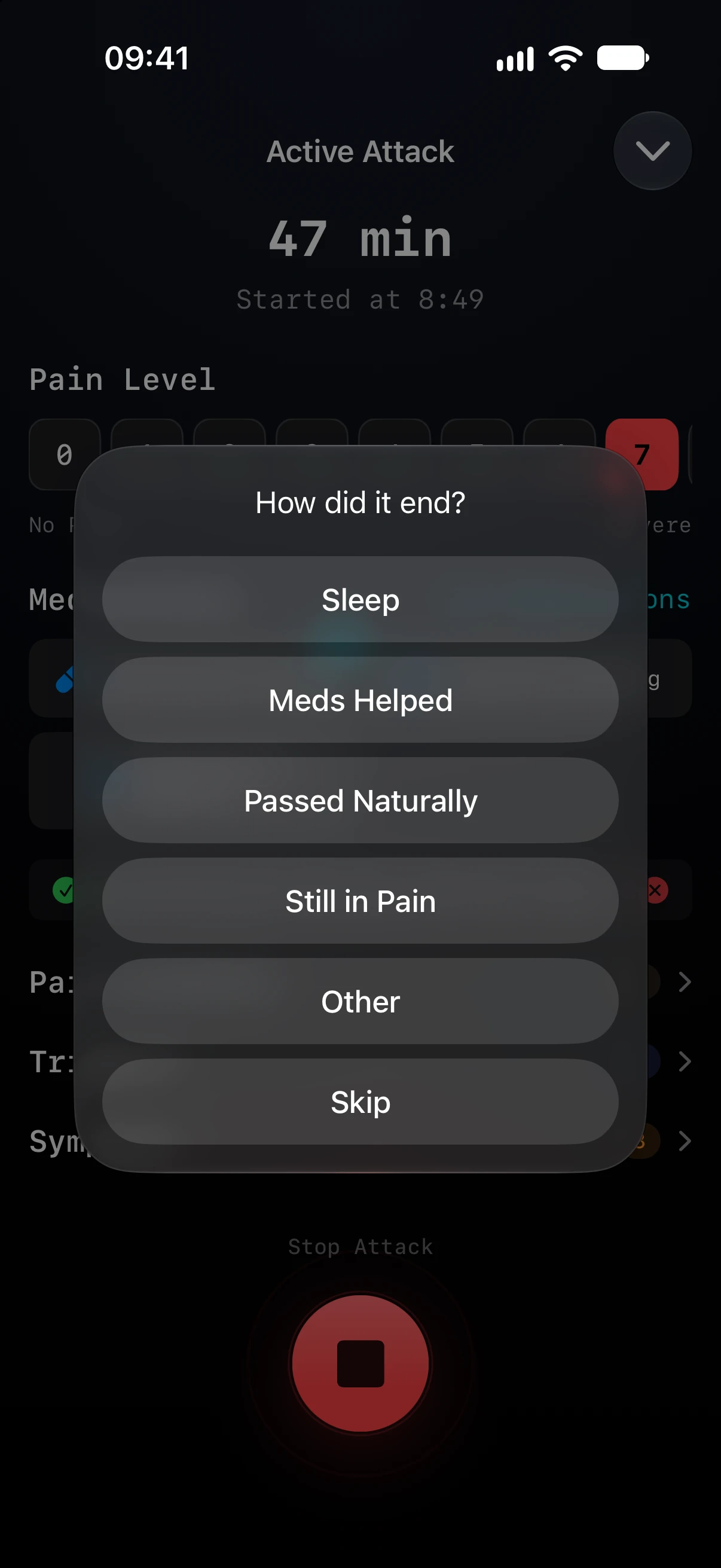
- Starting. Start Attack on the Today screen saves the current time as the start, and the Active Attack screen shows how long the attack has lasted. You can also start an attack with Siri or Shortcuts, or on Apple Watch with Premium. Only one attack can run at a time.
- Stopping. On the Active Attack screen, Stop Attack asks how the attack ended. The end time is the moment you tap, whichever answer you choose, and the answer cannot be changed later. Stopping from the banner on Today, from Attack Details or on Apple Watch saves no answer.
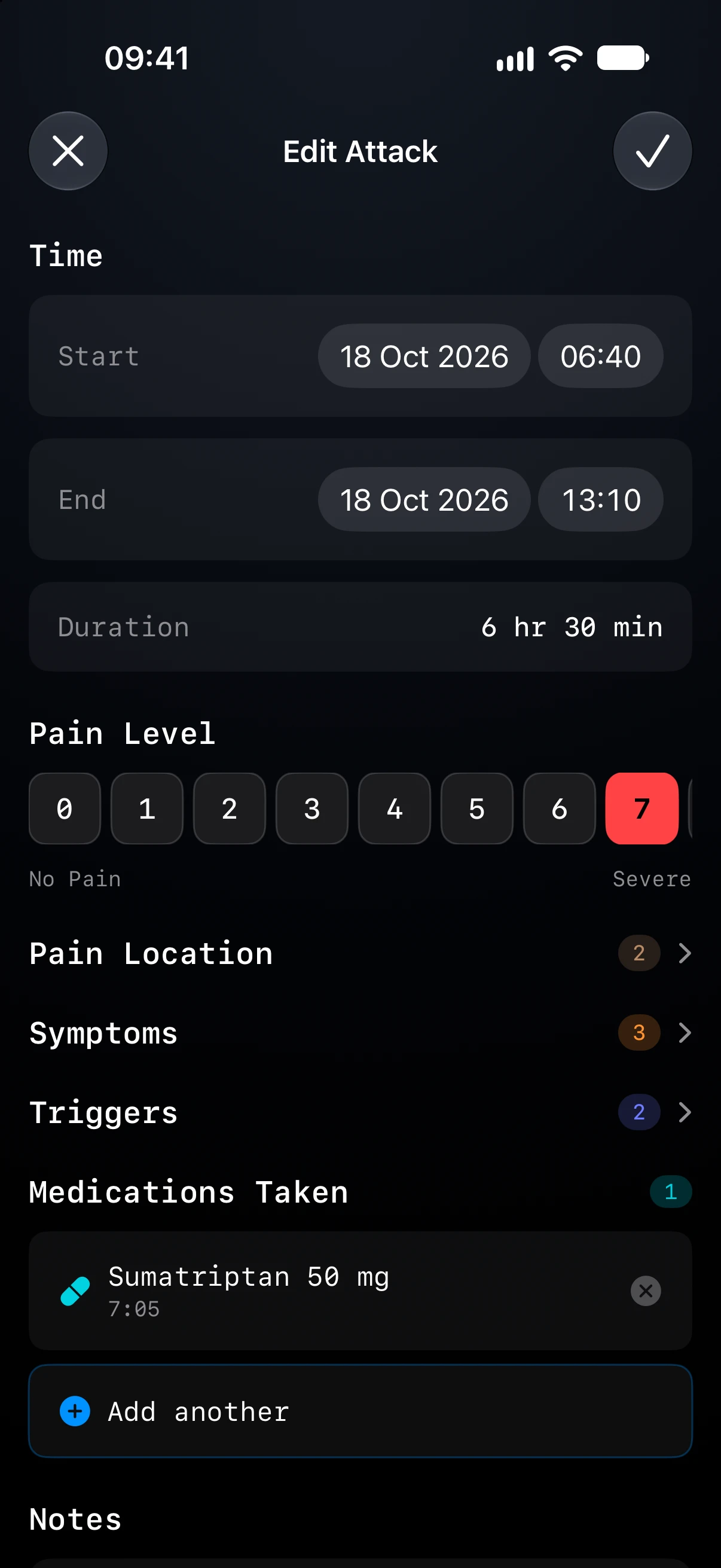
- Correcting. In History, open the attack and tap the pencil to change its Start and End; the Duration updates as you go. The end cannot be before the start or in the future. Saving changes to an attack that is still running also ends it, so stop it first. An ended attack cannot be restarted, so to keep pain that came back in the same entry, change the first attack’s End to when the pain finally stopped instead of starting a new attack. Add Past Attack, also in History, records an attack you did not start live.
- The 72-hour reminder. If an attack is still running after 72 hours and notifications are allowed, the app asks “Is your migraine attack still ongoing?”, and again every 72 hours until you stop it. It is a reminder to update the entry, not a medical alert, and it is not a Premium feature.
- Reports and exports. Reports shows Avg Duration from finished attacks only. The last 7 days are free; 30 and 90 days need Premium. With Premium, the CSV and JSON exports include each attack’s start, end, duration and end reason. In the CSV, the end time has no date of its own, so an attack that passes midnight is clearer in the JSON. The PDF report has no durations.
- Apple Health. When you stop a live attack, the app writes one Headache entry from its start to its end, if you allow it. Later changes to the times do not update that entry, as the Apple Health guide explains.
| Answer | What to check later |
|---|---|
| Sleep | If you stopped the attack at bedtime, change the end to when you woke up. |
| Meds Helped | If the pain comes back within 48 hours, apply your rule for a returning attack. |
| Passed Naturally | Note any after-effects, such as tiredness, separately. |
| Still in Pain | The entry ended when you tapped, but the pain had not. Change the End later to when the pain stopped. |
| Other | Add a note, because the answer has no text field. |
| Skip | No answer is saved. |
When not to wait
- The NHS says to “ask for an urgent GP appointment or get help from NHS 111” if you have a migraine attack and “it’s lasted longer than 72 hours”, “aura symptoms last longer than 1 hour at a time” or “you’re pregnant or just had a baby”. Outside the UK, contact your local urgent care service.
- The NHS says to call 999 if you “have a headache that came on suddenly and is extremely painful”, “have problems speaking or remembering things”, “lose your vision, or have blurred or double vision”, “feel drowsy or confused”, “have a seizure or fit”, “have a very high temperature and symptoms of meningitis”, “cannot move or have weakness in the arms or legs on 1 side of your body, or 1 side of your face” or “have recently had a head injury”. In the US, call 911. Elsewhere, call your local emergency number.
- The NHS also says to see a GP if “your migraine attacks are severe or getting worse, or lasting longer than usual” or if “you have migraine attacks more than once a week”.
- The app’s 72-hour reminder is a prompt to update your entry, not a medical alert. Don’t wait for it.
Information from the NHS website, as at 201026: Migraine.
Sources
- International Headache Society, ICHD-3: 1.1 Migraine without aura
- International Headache Society, ICHD-3: 1.2 Migraine with aura
- International Headache Society, ICHD-3: 1.4.1 Status migrainosus
- International Headache Society, ICHD-3: Definition of terms (duration and frequency of attacks, prodrome, postdrome)
- Headache Classification Committee of the International Headache Society. The International Classification of Headache Disorders, 3rd edition (PDF). Cephalalgia, 2018
- Diener et al. Guidelines of the International Headache Society for controlled trials of preventive treatment of migraine attacks in episodic migraine in adults. Cephalalgia, 2020
- van Casteren et al. Comparing perimenstrual and nonperimenstrual migraine attacks using an e-diary. Neurology, 2021
- NHS: Migraine, reviewed 10 March 2026
Sources checked on 20 October 2026. App details checked against Migraine Tracker 1.1.0. The worked example and the screenshots use fictional data.
Duration rules checked against ICHD-3 on 20 October 2026. App details checked against Migraine Tracker 1.1.0 on 20 October 2026. The worked example and the screenshots use fictional data. This guide explains record keeping, not diagnosis or treatment. The sources explain general principles and do not endorse Migraine Tracker.