
Tracking migraines around your period
Menstrual migraine is judged on the 2 days before a period and its first 3 days. How to record 3 cycles, count that window and use the app’s calendar.
The short answer
Menstrual migraine means migraine attacks linked to your period. To check for that pattern, record every attack and the first day of every period for at least 2 cycles. That is the minimum in the guideline from NICE, which advises the NHS in England. The Migraine Trust suggests at least 3 months.
The international headache classification, ICHD-3, looks at a 5-day window: the 2 days before a period starts and its first 3 days. The first day of bleeding is day 1, the day before is day −1, and there is no day 0. If your attacks keep falling in that window, in at least 2 of 3 cycles, take your diary to your GP.
The window doctors look at
NICE advises doctors to suspect menstrual-related migraine when attacks happen mainly from 2 days before to 3 days after a period starts, in at least 2 out of 3 consecutive cycles. It recommends confirming this with a headache diary kept for at least 2 cycles.
The International Classification of Headache Disorders (ICHD-3) defines the window exactly: days −2 to +3 of a period, where the first day of bleeding is day 1 and there is no day 0, in at least 2 out of 3 cycles. It separates two patterns:
- Pure menstrual migraine: attacks only on days −2 to +3 of a period, in at least 2 of 3 cycles, and at no other time of the cycle.
- Menstrually related migraine: attacks on days −2 to +3 in at least 2 of 3 cycles, and at other times too.
Pure menstrual migraine and menstrually related migraine are both in the ICHD-3 appendix, because experts are not yet sure they are separate disorders. For ICHD-3, a period also includes a withdrawal bleed, such as the bleed in the break from the combined pill or during cyclical hormone replacement therapy (HRT).
How common is menstrual migraine?
Menstrual migraine affects about 20 to 25% of women with migraine in the general population, according to a 2021 review in The Lancet Neurology. The review names two mechanisms: the fall in oestrogen before a period and the release of prostaglandins.
The NHS says migraine attacks “that happen just before or during your period” are “often longer and more severe than migraine attacks at other times” (Information from the NHS website, as at 191026: Migraine). In a 2021 Dutch e-diary study of 500 women, published in Neurology, attacks around a period lasted 20 hours on average, against 16 hours for other attacks, and were more likely to come back after easing.
Why a diary, not memory
Memory is a poor guide to whether migraine is linked to periods. ICHD-3 notes that many women over-report a link between their attacks and their periods, and it requires a diary over at least 3 cycles for research.
In a 2022 Dutch study published in Cephalalgia, 607 women first said whether they thought they had menstrual migraine, then kept an electronic diary. About two thirds met the diary criteria, both among women who thought they had menstrual migraine and among those who did not. The authors concluded that a diary kept as you go is needed for the diagnosis, in everyday practice as well as in research.
Two thirds is far more than the 20 to 25% found in the general population. The Lancet Neurology review notes that loose use of the criteria has led to conflicting figures, and chance adds to the count, as the worked example shows.
How to count the days
Count from the first day of bleeding, day 1. The day before is day −1. Because there is no day 0, the window is 5 days long. If a period starts on Wednesday 23 September, the window runs from Monday 21 to Friday 25 September.
| Day | Date | In the window? |
|---|---|---|
| Day −3 | Sunday 20 September | No |
| Day −2 | Monday 21 September | Yes |
| Day −1 | Tuesday 22 September | Yes |
| Day 1, first day of bleeding | Wednesday 23 September | Yes |
| Day 2 | Thursday 24 September | Yes |
| Day 3 | Friday 25 September | Yes |
| Day 4 | Saturday 26 September | No |
Note the day each attack starts. If an attack runs on into the next day, its start and end times show that, and your clinician can see both days.
The 5-day window works with irregular cycles too, because you count from the day bleeding actually started. Count from your logged first day, not from a predicted date.
If your migraine comes at the same time every month, check it against your cycle days, not calendar dates. A 26-day cycle starts about 4 days earlier each month. So attacks on the same date each month can fall on different days of your cycle, and attacks on the same day of your cycle can fall on different dates.
A worked example
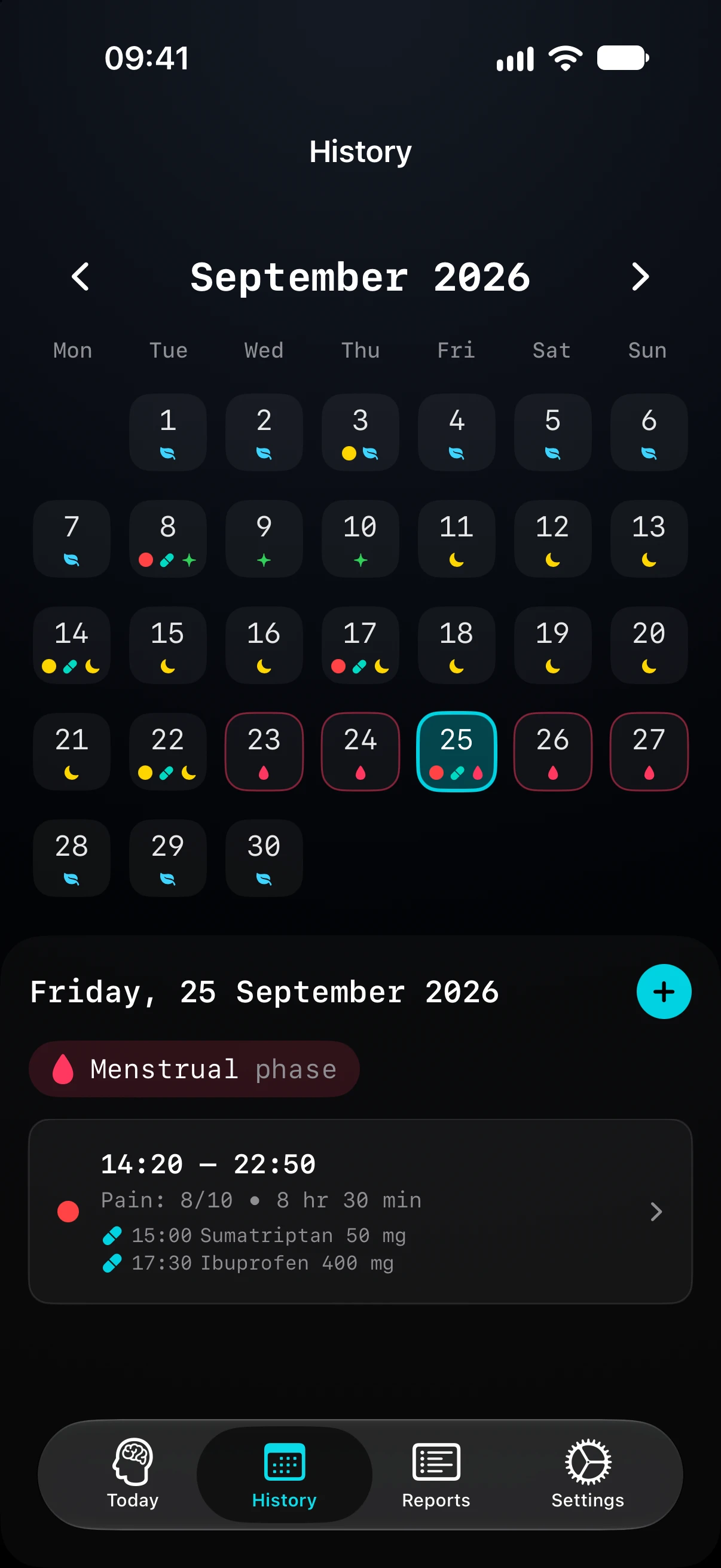
Here is a fictional diary with three periods, 28 days apart. The calendar screenshot from Migraine Tracker for iPhone and Apple Watch, under “How Migraine Tracker helps”, shows the third one.
| Period started | Window | Attacks in the window |
|---|---|---|
| Wednesday 29 July | 27 to 31 July | 28 July (day −1) and 31 July (day 3) |
| Wednesday 26 August | 24 to 28 August | 25 August (day −1) and 28 August (day 3) |
| Wednesday 23 September | 21 to 25 September | 22 September (day −1) and 25 September (day 3) |
Attacks fell in the window around all 3 periods. The same diary has 8 more attacks between the windows, on 3, 10, 15 and 18 August and on 3, 8, 14 and 17 September.
Attacks in the window in every cycle do not settle it on their own, because attacks can land there by chance. This diary has 6 attacks in each full cycle. If 6 attacks fell at random, at least one would land in a 5-day window in about 7 cycles out of 10. A 2023 Danish study in JAMA Network Open calculated that women with 8 or more migraine attacks a month had a 43% risk of meeting the ICHD-3 criteria for menstrually related migraine by chance.
So look at the share as well. Each 28-day cycle has 5 window days, so by chance fewer than 1 in 5 attacks would fall on them. In the two full cycles, from 29 July to 22 September, 4 of 12 attacks did: 1 in 3.
Attacks in the window in at least 2 of 3 cycles, as well as at other times, is the pattern ICHD-3 calls menstrually related migraine. Only a clinician can say whether it applies to you, and they will look at other causes too.
What to record each cycle
Each cycle, record the first day of your period and every attack, with the medicines you take, any aura and any change to hormonal contraception or HRT. Keep going for at least 2 cycles, ideally 3, so you and your clinician can check the 2-of-3 rule.
- The first day of each period. Everything else is counted from it. On iPhone, open the Health app, tap Browse, then Cycle Tracking, and tap a day in the timeline to log it as a period day. Health records spotting separately; if you are not sure which day counts as day 1, note both and ask your clinician. Health can also export a PDF of your cycle history for an appointment.
- Every attack, with the day and time it started. Include mild attacks. Leaving out attacks at other times would make the window look more important than it is.
- Medicines you take for attacks. NICE lists them among the things a headache diary should record, along with symptoms and how headaches relate to periods.
- Aura. Note it if you have it. ICHD-3 says attacks linked to periods are mostly without aura, and aura matters for some contraception choices, as described under “When to talk to someone”.
- Hormone changes. Note when you start, stop or take a break from the combined pill, patch or ring, or from HRT. ICHD-3 also notes that the link with periods can change over the years.
Is migraine linked to ovulation?
A large 2026 diary study found no rise in migraine attacks after ovulation, and ICHD-3 has no diagnosis for migraine around ovulation. In that Dutch study, published in Cephalalgia, 563 women with regular cycles kept an e-diary over 2,627 cycles. The days after ovulation, when oestrogen also falls, had no more attacks than other days; the days around a period had the most. The authors note that this contrasts with what many women with migraine believe.
If you think your attacks come mid-cycle, record them the same way. Your diary will show where in the cycle they fall, and your clinician can look at it with you.
How Migraine Tracker helps
Migraine Tracker shows your attacks and estimated cycle phases on one History calendar. The phases come from the periods you log in Apple Health on your iPhone. Cycle tracking is free, but you still count the window yourself.
- Cycle tracking is free. Turn it on in Settings → Menstrual Cycle → Track Menstrual Cycle. The app then reads the period days you log in Apple Health on your iPhone, if you have allowed it to read menstruation data. It reads the days you logged and does not use Health’s predictions. It looks back 12 months and does not write cycle data to Health. On iOS 27, choose All Recorded Data and Future Data when Health asks how much past data to share: with Past 30 Days and Future Data, the app may find only one period and use the default cycle length until you log more.
- Phases on the calendar. In History, each day shows an icon for its estimated phase: Menstrual, Follicular, Ovulation or Luteal. Days 1 to 5 of each cycle have a pink border. Select a day to see its phase.
- The phases are estimates. The app starts each cycle on the first logged day of a period and places ovulation about 14 days before the next expected period, from your average cycle length. Cycles shorter than 21 or longer than 35 days are left out of that average. If it cannot work out an average yet, for example with only one period logged, it uses the default cycle length in Settings: 28 days unless you change it. Without period data in Health, it shows no phases. If a new period is not logged, the icons stop about a week after it was due.
- The pink border is not the window. It marks days 1 to 5, while the window runs from day −2 to day 3. Count back 2 days from the first pink day. In the screenshot, that puts the attack on 22 September, a Luteal day in the app, inside the window.
- Triggers. When you log an attack, you can select Menstruation, Ovulation or PMS. These are labels you choose; the app does not add them from your Health data.
- PDF reports. With Premium, the calendar in a PDF report marks period days from Health next to attack days, so your clinician sees both on one page. The PDF report guide shows the steps.
- You do the counting. The app does not count attacks in the window or check the 2-of-3 rule for you. The guide to how long to keep a headache diary covers the other questions a diary can answer.
When to talk to someone
- The NHS says to see a GP if “you regularly get migraine before or during your period”. Take your diary with you. It also says to see a GP if “your migraine attacks are severe or getting worse, or lasting longer than usual” or if “you have migraine attacks more than once a week”.
- The NHS says the combined pill, the contraceptive patch and the vaginal ring “may not be suitable” if you have ever had “migraines with warning signs called aura”. It says to “talk to a doctor, nurse or pharmacist about whether it’s safe for you” to use them. Talk to your GP before you start, stop or change contraception or HRT because of a pattern in your diary.
- The NHS says to “ask for an urgent GP appointment or get help from NHS 111” if you have a migraine attack and “it’s lasted longer than 72 hours”, “aura symptoms last longer than 1 hour at a time” or “you’re pregnant or just had a baby”. Outside the UK, contact your local urgent care service.
- The NHS says to call 999 if you “have a headache that came on suddenly and is extremely painful”, “have problems speaking or remembering things”, “lose your vision, or have blurred or double vision”, “cannot move or have weakness in the arms or legs on 1 side of your body, or 1 side of your face” or “have a seizure or fit”. Elsewhere, call your local emergency number.
Information from the NHS website, as at 191026: Migraine, Who can take the combined pill, Who can use the contraceptive patch and Who can use the vaginal ring.
Sources
- NICE CG150: Headaches in over 12s, recommendations 1.1.4, 1.2.5 and 1.2.6 (last updated 3 June 2025)
- ICHD-3: A1.1.1 Pure menstrual migraine without aura
- ICHD-3: A1.1.2 Menstrually related migraine without aura
- ICHD-3: A1.1.3 Non-menstrual migraine without aura, with comments on all three
- Vetvik and MacGregor. Menstrual migraine: a distinct disorder needing greater recognition. The Lancet Neurology, 2021
- van Casteren et al. Comparing perimenstrual and nonperimenstrual migraine attacks using an e-diary. Neurology, 2021
- Verhagen et al. Validation of diagnostic ICHD-3 criteria for menstrual migraine. Cephalalgia, 2022
- Chalmer et al. Population-based characterization of menstrual migraine and proposed diagnostic criteria. JAMA Network Open, 2023
- van der Arend et al. Migraine attack incidence in relation to the post-ovulatory estrogen decline. Cephalalgia, 2026
- The Migraine Trust: Menstrual migraine
- NHS: Migraine
- NHS: Who can take the combined pill
- NHS: Who can use the contraceptive patch
- NHS: Who can use the vaginal ring
- Apple: Log menstrual cycle information in Health on iPhone
- Apple: View menstrual cycle predictions and history in Health on iPhone
Sources checked on 16 October 2026. The worked example and the screenshot use fictional demonstration data.
Criteria checked against ICHD-3 and NICE on 16 October 2026. App details checked against Migraine Tracker 1.0.9. The worked example and the screenshot use fictional demonstration data. This guide explains record keeping, not diagnosis or treatment. The sources explain general principles and do not endorse Migraine Tracker.