
Why do I get migraines on weekends? Let-down, sleep, caffeine
In a large 2026 diary study, about 1 in 7 people with migraine had a weekend-heavy pattern. What research says about let-down, sleep and caffeine.
The short answer
Most people with migraine do not have more attacks at weekends. In a large study published in 2026, researchers analysed headache diaries from more than 7,600 users of a German diary app. About one in seven had a weekend-heavy pattern, and nearly one in five of those with episodic migraine. For most of them, the pattern changed over time.
Three explanations come up most often: stress letting go after a busy week, a different sleep pattern and caffeine at a different time. Each has some support, mostly from small studies, and none has been shown to cause weekend attacks in general. Your own diary can show whether your attacks really cluster at weekends, and what changed before them.
Is weekend migraine real?
Researchers have looked at this question for decades. The authors of the 2026 study summed up earlier work: “It has long been proposed that some individuals with migraine are especially prone to experience headache on weekends, however, results have been contradictory.”
| Study and participants | What it found |
|---|---|
| Ruscheweyh et al., 2026, Germany: 7,633 users of the German Migraine and Headache Society’s diary app, in two samples | Differences between days of the week were small overall. 14–15% had a weekend-heavy pattern: 18% of those with episodic migraine and about 3% of those with chronic migraine. People in work were more likely to have it. Of 468 people who showed the pattern in at least one part of their records, only 16 showed it in all four parts. |
| Drescher et al., 2019: 1,085 people who logged 44,639 attacks in the online Migraine Radar tool | For 15.9%, attacks were not spread evenly over the week. Saturday was the peak day for more people than any other day: 195 of the 1,085. |
| Alstadhaug et al., 2007, Norway: 84 women who recorded 2,314 attacks for up to a year | Attacks were spread almost evenly over the week, except on Sundays, when there were significantly fewer. The authors concluded that “days off protect against migraine”. |
| Morrison, 1990: 35 women, six-week diaries | No significant increase in attacks at weekends, either in the whole group or among those in paid work. |
| Couturier et al., 1992, London: A questionnaire for 151 patients of a migraine clinic | 21.9% reported weekend attacks. Among those who had a lot of caffeine every day and woke much later at weekends, 69% had weekend headaches; with only one of the two, 4% did. |
So a weekend pattern seems real for a minority, not a rule for everyone. The 2026 authors add a caution that matters for anyone checking their own records: “part of this effect might be due to patients recording headache more reliably on their free days, compared to workdays”.
Stress letting go
The best-known explanation is the “let-down” effect: attacks that start after stress eases, for example at the end of a working week. The Migraine Trust describes it this way: “You might notice it happening on a weekend or when you have a break from work.”
The main study behind it is small. In 2014, 17 people with migraine at a US headache centre kept an electronic diary for 12 weeks, rated their stress every evening and recorded 110 attacks. A fall in stress from one evening to the next was followed by more attacks over the next 6, 12 and 18 hours. In the 6 hours after any fall, the odds of an attack were about 4.8 times as high, but that estimate rests on 17 attacks, and its 95% confidence interval runs from 1.4 to 16.5. The study did not look at weekends. Its authors also considered that they “may have reversed cause and effect”, because the early phase of an attack can change how people feel, although they thought this unlikely.
Other diary data are mixed. In an app study of 351 people, 16.7% of migraine episodes followed a let-down pattern of stress. In the 2026 study, people in work were three to four times as likely to be in the weekend group. The authors say this supports the idea that release from stress could trigger attacks, though changes in sleep, caffeine and alcohol might also contribute. The same mix can show up over a holiday, as our post on Christmas and migraine explains.
A different sleep pattern
Weekends often mean going to bed later and sleeping in. In a survey of 1,207 patients at a US headache centre, 32% of those who reported triggers named sleeping late. The Migraine Trust notes that some people find “having more sleep than usual, for example having a lie-in on a weekend, can increase the risk of a migraine attack”.
Measured sleep tells a less clear story. In a 2020 study, 98 adults with episodic migraine wore a wrist sleep tracker and kept a diary for six weeks. The researchers found no link between short or long sleep, as the tracker measured it, and a headache the following day.
The 1992 London survey came to a similar view of lie-ins: “Sleeping in is not on its own a significant cause.” Weekend headaches became common when a late wake-up came together with a lot of caffeine, which leads to the third explanation. A clock change is another shift in routine; our post on daylight saving time and migraine looks at that evidence.
Caffeine at a different time
If you have coffee early on workdays, a lie-in also delays your first caffeine of the day. The international headache classification, ICHD-3, describes caffeine-withdrawal headache in people who have had more than 200 mg of caffeine a day for more than two weeks. It develops “within 24 hours after last caffeine intake” and is relieved within an hour by 100 mg of caffeine, or resolves within seven days without caffeine. That is a separate type of headache, not a migraine attack.
Sudden withdrawal may also trigger migraine itself. In a small trial that was stopped early, it “triggered severe migraine attacks” in seven of nine people with migraine who had about 540 mg of caffeine a day.
In everyday life, weekend caffeine-withdrawal headache seems uncommon. A population study in Vågå, Norway, found it in 7 of 1,741 people (0.4%), and it “occurred mainly in the morning hours on weekends”.
How many is more than chance?
Two days in seven fall on a weekend. So even if the day made no difference at all, about 2 in 7 attacks (29%) would start on a Saturday or Sunday. If you record 12 attacks over three months, chance alone would put about 3 or 4 of them at a weekend, and sometimes more.
| Weekend attacks out of 12 | How often chance alone gives at least this many |
|---|---|
| 4 or more | About 1 time in 2 (46%) |
| 5 or more | About 1 time in 4 (24%) |
| 6 or more | About 1 time in 10 (10%) |
| 7 or more | About 1 time in 33 (3%) |
| 8 or more | Less than 1 time in 100 (0.7%) |
Binomial probabilities, assuming each attack is equally likely to start on any day of the week. They show how easily a cluster appears by chance. They are not a test of your own diary.
Check your own diary
- Count each attack once, on the day it started. An attack that begins late on Friday and goes on into Saturday is a Friday attack. Migraine Tracker’s calendar marks attacks the same way.
- Record workday headaches as carefully as weekend ones. A busy week makes it easy to skip entries, and that alone can make weekends look worse.
- Collect enough attacks. With fewer than about 10, a weekend cluster easily appears by chance. Three months is a sensible minimum for most people.
- Note what changed before each weekend attack. When did a stressful week end? When did you go to bed and wake up? When did you have your first coffee? Times tell you more than labels.
- Compare with weekends without an attack. If you sleep in on most weekends, a lie-in before every weekend attack tells you little.
- Treat a pattern as a question. A pattern in a diary is a starting point, not proof of a cause. Bring it to your next appointment.
Here is a fictional example. Over three months you logged 12 attacks, and 6 of them started on a Saturday or Sunday. Chance alone gives that many about one time in ten. Your notes show that five of the six came after you slept at least two hours longer than on workdays, but you also slept in on most weekends without an attack. That is worth mentioning at your next appointment. It does not show that sleeping in causes your attacks.
What Migraine Tracker records
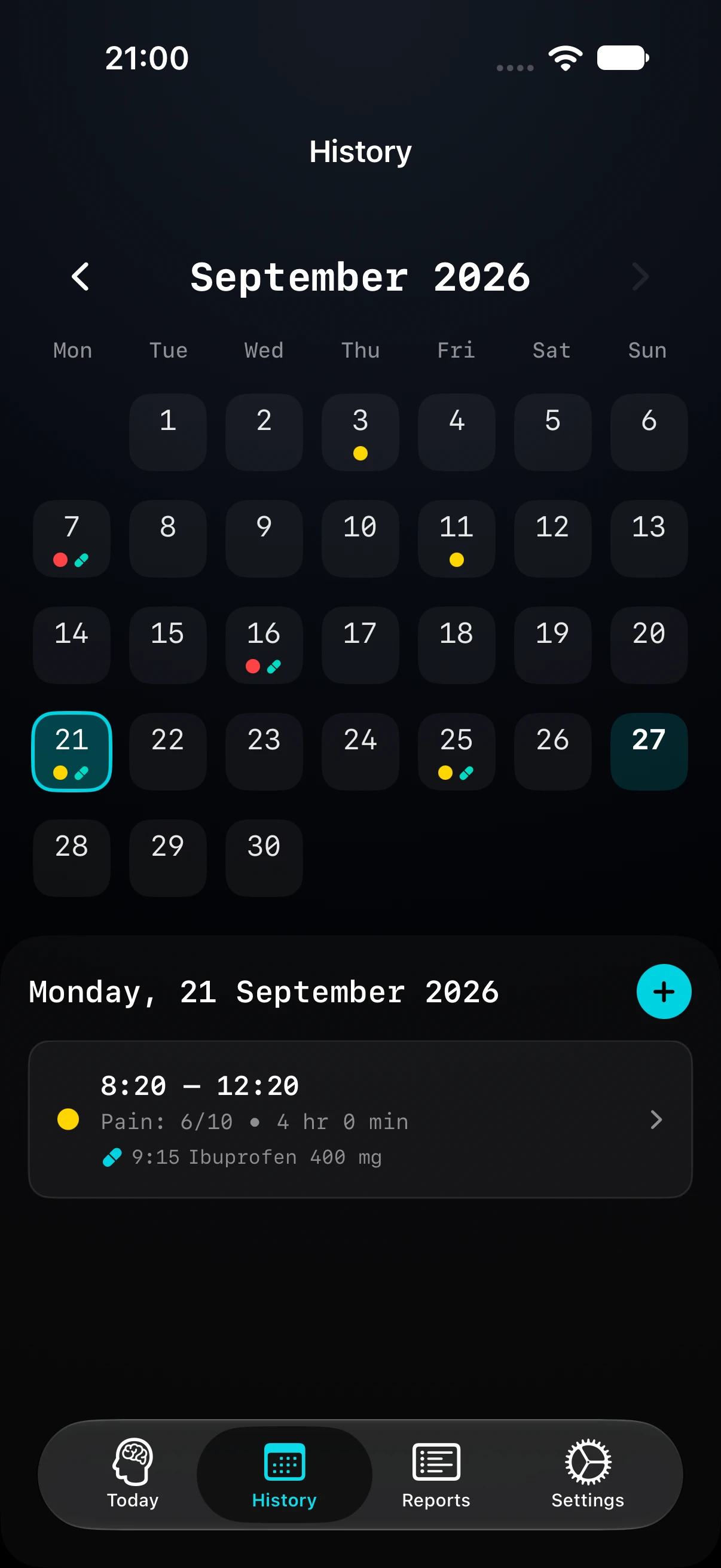
- Weekdays in columns. History shows each month in weekly rows. The first day of the week follows your iPhone’s region settings.
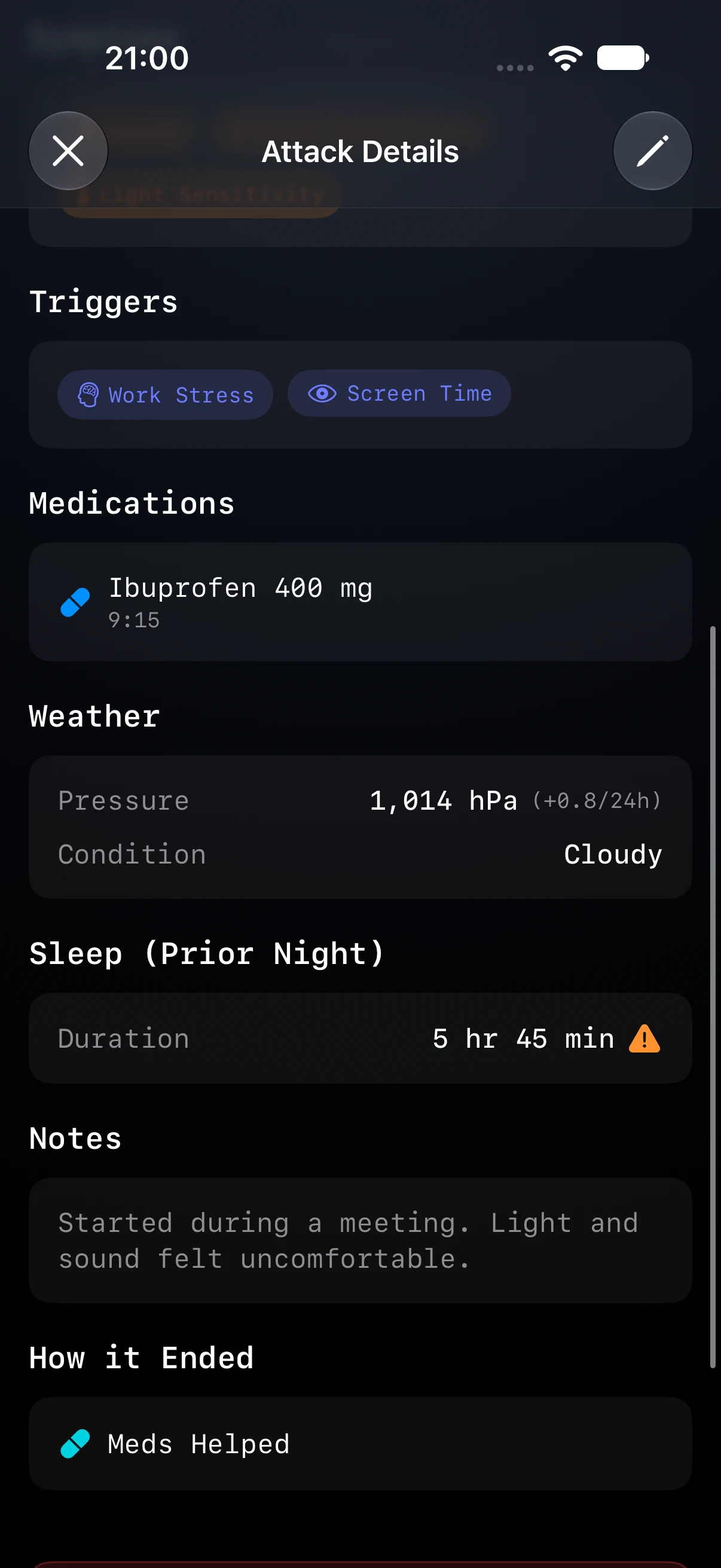
- Triggers for weekend changes. The built-in list includes Letdown (Weekend), Too Much Sleep, Irregular Schedule, Caffeine Withdrawal and Excess Caffeine, alongside Too Little Sleep, Poor Sleep Quality, Napping and Work Stress. You can choose several for one attack. A trigger records what you suspected, not what caused the attack.
- Last night’s sleep. When you start an attack in the app, on Apple Watch or with Siri, Migraine Tracker saves how long you slept the night before from Apple Health, if you have allowed access and sleep data is available. Attacks you add later have no sleep reading.
- Notes for times. Use the note to record when you woke up, had your first coffee or finished a stressful week.
- No day-of-week count. The app does not count attacks by weekday. With Premium, the CSV export lists each attack’s date for the last 7, 30 or 90 days, so a spreadsheet’s WEEKDAY function can count them for you.
- Trigger summary. With Premium, Reports show how often you logged each trigger over 30 or 90 days.
When to talk to someone
- The NHS says to see a GP if “your migraine attacks are severe or getting worse, or lasting longer than usual” or if “you have migraine attacks more than once a week”.
- The Migraine Trust notes that “cutting out caffeine suddenly can also trigger migraine attacks”. If you want to change how much caffeine you have, talk to your GP or pharmacist first.
- The NHS says to call 999 if you “have a headache that came on suddenly and is extremely painful”. Elsewhere, call your local emergency number.
Information from the NHS website, as at 061126: Migraine.
Sources
- Ruscheweyh et al. Weekend headache in migraine – fact or fiction? An observational study from DMKG-app data. Cephalalgia, 2026
- Drescher et al. Distribution of migraine attacks over the days of the week: preliminary results from a web-based questionnaire. Acta Neurologica Scandinavica, 2019
- Alstadhaug et al. Weekend migraine. Cephalalgia, 2007
- Morrison. Occupational stress in migraine – is weekend headache a myth or reality? Cephalalgia, 1990
- Couturier et al. Weekend attacks in migraine patients: caused by caffeine withdrawal? Cephalalgia, 1992
- Lipton et al. Reduction in perceived stress as a migraine trigger: testing the “let-down headache” hypothesis. Neurology, 2014
- Vives-Mestres et al. Patterns of perceived stress throughout the migraine cycle: a longitudinal cohort study using daily prospective diary data. Headache, 2021
- Kelman. The triggers or precipitants of the acute migraine attack. Cephalalgia, 2007
- Bertisch et al. Nightly sleep duration, fragmentation, and quality and daily risk of migraine. Neurology, 2020
- Alstadhaug et al. Sudden caffeine withdrawal triggers migraine – a randomized controlled trial. Frontiers in Neurology, 2020
- Sjaastad and Bakketeig. Caffeine-withdrawal headache: the Vågå study of headache epidemiology. Cephalalgia, 2004
- ICHD-3: 8.3.1 Caffeine-withdrawal headache
- The Migraine Trust: Migraine and stress
- The Migraine Trust: Common triggers
- NHS: Migraine
Sources checked on 14 October 2026. The worked example and app screens use fictional demonstration data.
App details checked against Migraine Tracker 1.0.9 on 14 October 2026. App screens and the worked example use fictional demonstration data. This post explains research and record keeping, not medical advice. The sources explain general principles and do not endorse Migraine Tracker.