
Headache days vs migraine days: how to count them in your diary
Headache and migraine days are counted by date, not by attack. Learn the difference, when frequent headache days count as chronic migraine and what Migraine Tracker’s day counts include.
The short answer
A headache day is a calendar day on which you had a headache of any kind. A migraine day is a headache day on which the headache had migraine features. Every migraine day is also a headache day, but not every headache day is a migraine day.
Both are counted by date, not by attack. One attack that lasts from Friday night to Sunday morning covers three dates. Two separate attacks on the same Tuesday count as one day.
Why clinicians count days, not attacks
When headaches are frequent, separate attacks can be hard to tell apart. The International Classification of Headache Disorders (ICHD-3) says this directly: with very frequent or continuous headache, it is “impossible to distinguish the individual episodes”, and the headache can change even within the same day.
A count of days avoids that problem and gives you a number you can compare from month to month. ICHD-3 adds that frequently recurring headache generally needs a diary that records pain and associated symptoms day by day for at least one month.
Migraine features are the characteristics used to diagnose migraine. They include one-sided or throbbing pain, moderate or severe pain, pain made worse by routine activity, nausea, and sensitivity to light and sound. A milder headache without those features still counts as a headache day.
Exact definitions vary. Clinical trials use stricter rules: the International Headache Society’s guidelines for trials in episodic migraine count a migraine day when a headache lasts at least 30 minutes without painkillers and meets the criteria for migraine or probable migraine, or when it responds to a migraine-specific acute medicine. If your clinician asks for a count, ask whether they want every headache day or only migraine-like days.
When do headache days count as chronic migraine?
ICHD-3 describes chronic migraine as headache on 15 or more days a month for more than three months, with migraine features on at least 8 of those days. A day can also count towards the 8 if you believed it was migraine when it started and a triptan or ergot medicine relieved it. With fewer headache days, migraine is generally described as episodic.
The threshold counts days, not attacks. Eight attacks a month that each last into a second day cover 16 dates.
These numbers are only part of the criteria. A diagnosis also depends on your headache history and on ruling out other causes, and only a clinician can make it. ICHD-3 notes that medication overuse is the most common cause of symptoms that suggest chronic migraine, which is one reason clinicians also ask on how many days you used acute medicine.
The American Migraine Foundation points out that many people underestimate their headache days, because they count the really bad days and discount the milder ones. A diary that includes milder headaches gives a more complete count.
A worked example
Here is a fictional month with four recorded attacks.
| Recorded attack | Dates with headache |
|---|---|
| 4 Sept, 09:00–17:00 | 4 Sept |
| 12 Sept, 22:00 to 14 Sept, 11:00 | 12, 13 and 14 Sept |
| 20 Sept, 07:00–10:00 | 20 Sept |
| 20 Sept, 18:00–23:00 | 20 Sept |
- Attacks
- 4
- Headache days, counted day by day
- 5
- Headache Days in Migraine Tracker
- 3
Counted day by day, the month has five headache days: 4, 12, 13, 14 and 20 September. The two attacks on 20 September share one date. The attack that started late on 12 September continued over the next two dates.
If the morning attack on 20 September had migraine features and the evening one did not, 20 September is still a migraine day. The milder evening headache does not add another day.
Migraine Tracker shows 3 for this month, because it counts the dates on which attacks started: 4, 12 and 20 September. The next section explains why.
How Migraine Tracker counts days
In Reports, Headache Days is the number of dates on which at least one recorded attack started in the selected period. Without Premium, Reports shows the last 7 days; Premium adds 30- and 90-day views.
The PDF report shows the same number as Migraine Days, with an average per month based on 30-day blocks. The monthly table on page 2 counts it for each calendar month. Open the sample PDF to see both.
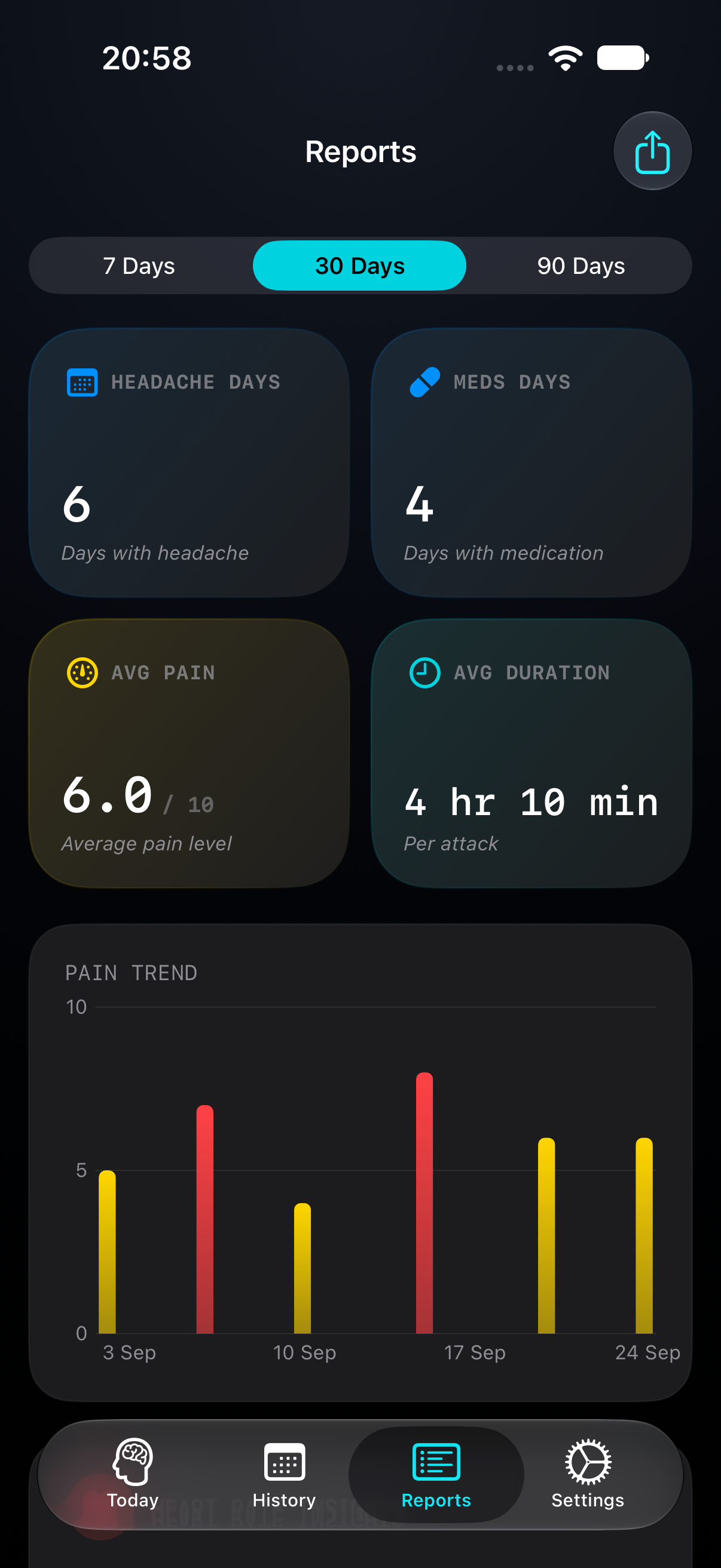
- A long attack counts once, on its start date. The calendar marks that date too. That is why the worked example shows 3 in the app and 5 when counted day by day.
- Two attacks on one date count as one day. The number of attacks and the number of days can differ.
- The app does not label attacks as migraine or another type of headache. Headache Days in Reports and Migraine Days in the PDF are the same count of your recorded attacks. Whether a day was a migraine day in the clinical sense depends on what you experienced and recorded.
- Meds Days counts dates with at least one acute medication entry, using the time you logged it. Medicine logged on the second day of a long attack counts on that date, even though the app does not count that date as a Headache Day. Medicines saved as preventive are not included.
- Days without an entry are not counted. An empty date is not confirmed to be headache-free.
Record a count you can rely on
- Agree what to include. If your clinician wants every headache day, record milder headaches as attacks too, with their own pain level and a short note such as “mild, not like my usual migraine”. The PDF will still call them Migraine Days, so mention that when you share it.
- Keep a long attack as one entry. Enter its real start and end times instead of splitting it into daily entries, so attack counts and durations stay accurate. When you need a day-by-day count, open the entry and count the dates from start to end, or add a note such as “headache continued on 13 and 14 Sept”.
- Handle a returning headache the same way each time. If pain eases and comes back later, decide whether you record it as a new attack or keep it in the same entry, and keep to that choice.
- Compare the same kind of period. The 30 Days view in Reports covers the last 30 days up to now, while the PDF’s monthly table uses calendar months. Compare 30 days with 30 days, or a month with a month.
- Bring the entries as well as the totals. The PDF report guide shows what the report includes and what stays in your diary. The appointment checklist helps you prepare the rest.
Sources
- ICHD-3: 1.3 Chronic migraine
- ICHD-3: 1.1 Migraine without aura
- ICHD-3: 1.4.1 Status migrainosus
- Diener, Tassorelli et al. Guidelines of the International Headache Society for controlled trials of preventive treatment of migraine attacks in episodic migraine in adults. Cephalalgia, 2020
- American Migraine Foundation: What is chronic migraine?
- NHS: Migraine
Sources checked on 8 October 2026. The worked example and app screen use fictional demonstration data.
Counting rules checked against Migraine Tracker 1.0.9 on 8 October 2026. The app screen and the worked example use fictional demonstration data. This guide explains record keeping, not diagnosis or treatment. The sources explain general principles and do not endorse Migraine Tracker.