
Triptan and painkiller days per month: how to count them
Medication overuse criteria count days, not tablets. Learn how to count your triptan and painkiller days, and what the 10- and 15-day thresholds mean.
The short answer
Headache specialists count medication days: the dates on which you took at least one dose of a medicine for headache. Two tablets on the same day make one medication day. A dose late in the evening and another one after midnight make two.
The international headache classification, ICHD-3, links medication overuse headache to triptans on 10 or more days a month, and to simple painkillers such as paracetamol, aspirin or ibuprofen on 15 or more days a month, for more than three months. These numbers are diagnostic criteria, not safe limits. Ask the person who prescribes or recommends your medicine what applies to you.
Why days, not doses
Medication overuse headache is headache that develops or gets worse when acute headache medicines are taken too often. ICHD-3 describes it with three criteria:
- headache “on ≥15 days/month in a patient with a pre-existing headache disorder”;
- “regular overuse for >3 months of one or more drugs that can be taken for acute and/or symptomatic treatment of headache”;
- no other ICHD-3 diagnosis that explains it better.
The thresholds for overuse are written in days. For triptans, the criterion is “regular intake of one or more triptans, in any formulation, on ≥10 days/month for >3 months”. What counts is the number of days with any intake, not the number of tablets taken on those days. ICHD-3 adds that these numbers of days “are based on expert opinion rather than on formal evidence”.
That is why a count of tablets, or of attacks, does not answer the question your clinician is likely to ask. The German neurology and headache societies’ guideline says the diagnosis rests partly on “days of headache medication use documented in a headache diary”. Headache days are counted the same way, by date. Our guide to headache days vs migraine days explains that count.
How many doses you can take in one day is a separate question. It depends on the medicine and is set out in its leaflet or by your prescriber. This guide is only about counting days.
The 10- and 15-day thresholds
ICHD-3 sets a different threshold for each type of medicine. Each one applies to regular use for more than three months.
| Type of medicine | Days a month |
|---|---|
| Triptans, such as sumatriptan or rizatriptan | 10 or more |
| Ergotamine | 10 or more |
| Opioids, such as codeine | 10 or more |
| Combination painkillers, which mix different types of drug, such as paracetamol with codeine, or a painkiller with caffeine | 10 or more |
| Simple painkillers: paracetamol, aspirin, ibuprofen and other NSAIDs, counted together | 15 or more |
| Different types together, when none reaches its own threshold | 10 or more in total |
Two rules matter when you add up days. ICHD-3 treats all simple painkillers as one class, so paracetamol on some days and ibuprofen on others count towards the same 15. A tablet that combines only two simple painkillers, such as aspirin with paracetamol, also counts as a simple painkiller. And if you use different types, for example a triptan on some days and a painkiller on others, ICHD-3 adds the days together towards a total of 10, even when no single type reaches its own threshold.
NICE, which advises the NHS in England, uses the same numbers. It tells doctors to be alert to medication overuse headache in people whose headache developed or worsened while they took “triptans, opioids, ergots or combination analgesic medications on 10 days per month or more or paracetamol, aspirin or an NSAID, either alone or in any combination, on 15 days per month or more” for three months or more.
Advice for patients is often stricter than the diagnostic thresholds. The NHS page on migraine says: “Try not to take painkillers for more than 2 days a week as this can cause you to get more headaches and make migraine harder to treat.” The American Migraine Foundation calls needing acute medicine more than two or three days a week “the first red flag”.
ICHD-3 was published in 2018. Its medication overuse criteria do not mention gepants, such as rimegepant or ubrogepant, or lasmiditan. If you use one of these, ask your clinician whether and how they want you to count it.
A worked example
Here is a fictional month with seven doses of acute medicine.
| Date | Recorded medicine | Counts as |
|---|---|---|
| 3 Sept | Ibuprofen at 09:00 and again at 16:00 | 1 painkiller day |
| 7 Sept | Triptan at 08:00 | 1 triptan day |
| 12 Sept | Triptan at 22:30, early in an attack that lasted overnight | 1 triptan day |
| 13 Sept | Ibuprofen at 07:00, in the same attack | 1 painkiller day |
| 20 Sept | Triptan at 08:00, ibuprofen at 13:00 | 1 triptan day and 1 painkiller day |
- Doses
- 7
- Days with any acute medicine
- 5
- Triptan days
- 3
- Painkiller days
- 3
Seven doses fall on five dates, so the month has five medication days. The two ibuprofen doses on 3 September share one date. The overnight attack on 12 and 13 September is one attack but two medication days, because its doses fall on two dates.
Counted by type, the month has three triptan days (7, 12 and 20 September) and three painkiller days (3, 13 and 20 September). On 20 September both types were taken, so that date appears in both counts but only once in the total.
The total of five is the number ICHD-3 compares with 10 when different types are used together. Migraine Tracker would also show 5 for this month. The next section explains what it counts.
How Migraine Tracker counts medication days
In Reports, Meds Days is the number of dates in the selected period with at least one acute medicine entry. Without Premium, Reports shows the last 7 days; Premium adds 30- and 90-day views.
The PDF report, a Premium feature, shows the same count as Acute Med Days, with an average per month. On page 2, the calendar marks each medication day, and the monthly summary counts Med Days for each calendar month.
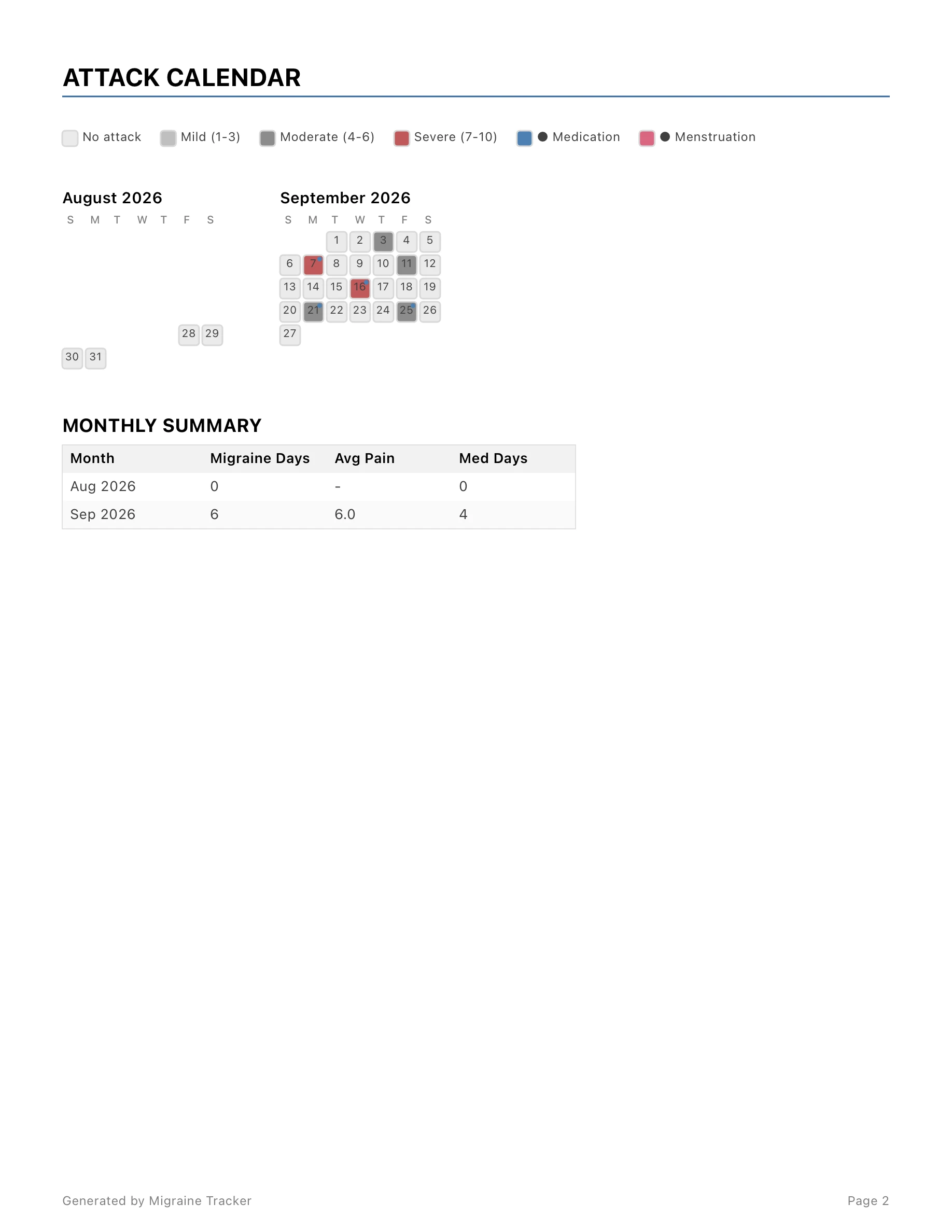
- Doses on the same date count once. Meds Days is a count of dates, like the clinical count.
- Each dose counts on the date you logged it. In a long attack, medicine taken after midnight counts on the new date.
- Every medicine saved as Acute is included. In the built-in list, that means painkillers, triptans, gepants and an anti-sickness medicine. Meds Days is therefore your count of days with any acute medicine, not a triptan count. To count triptan days on their own, open your entries in History and count the dates with a triptan.
- Preventive medicines are not counted. You choose Acute or Preventive when you add a medicine in Settings → My Medications.
- Medicine is logged with an attack. You can add it during a live attack, on Apple Watch, or when you add or edit a past attack. Its time has to fall between the attack’s start and end.
- The app counts; it does not judge the count. It does not warn you when medication days get high or tell you what is too many.
Record a count you can rely on
- Log every dose, including medicine for milder headaches. A missed entry makes the count look lower than it was.
- Log the time you actually took it. When you add an attack later, set Time Taken for each medicine, so a dose after midnight lands on the right date.
- Save each medicine with the right type. Acute is for relieving an attack, Preventive for daily prevention. A medicine saved with the wrong type is counted, or missed, in every report.
- Mention medicine you take for other pain. ICHD-3 refers to drugs that “can be taken” for headache, so ibuprofen for back pain may matter too. Migraine Tracker logs medicine with attacks, so keep a separate note of other use and tell your clinician.
- Compare calendar months, and look at three or more. The thresholds are per month and apply over more than three months. The PDF’s monthly table gives calendar-month counts, while the 30 Days view in Reports covers the last 30 days up to now.
- Bring the entries as well as the totals. The PDF report guide shows what the report includes, and the appointment checklist helps you prepare the rest. To count headache days in the same careful way, see headache days vs migraine days.
Sources
- ICHD-3: 8.2 Medication-overuse headache
- ICHD-3: 8.2.2 Triptan-overuse headache
- ICHD-3: 8.2.3 Non-opioid analgesic-overuse headache
- ICHD-3: 8.2.6 Medication-overuse headache attributed to multiple drug classes not individually overused
- NICE CG150: Headaches in over 12s, recommendations (last updated 3 June 2025)
- Diener et al. Management of medication overuse (MO) and medication overuse headache (MOH) S1 guideline. Neurological Research and Practice, 2022
- NHS: Migraine
- American Migraine Foundation: What is medication overuse headache?
- American Migraine Foundation: Medication overuse headache
Sources checked on 8 October 2026. The worked example and the sample PDF use fictional demonstration data.
Counting rules checked against Migraine Tracker 1.0.9 on 8 October 2026. The worked example and the sample PDF use fictional demonstration data. This guide explains record keeping, not diagnosis, treatment or dosing. The sources explain general principles and do not endorse Migraine Tracker.