
Botox for chronic migraine: what your diary needs to show
For chronic migraine, US plans and Medicare ask for 15 or more headache days a month, often lasting 4 hours or more. What to record before and after Botox.
The short answer
In the US, the FDA has approved Botox (onabotulinumtoxinA) to prevent headaches in adults with chronic migraine: 15 or more days a month with headache lasting 4 hours a day or longer. Medicare’s rules in most states also ask for 8 or more migraine days a month, at least 3 months of history and earlier preventive treatments from 2 classes, unless you could not take them. Private plans set their own, similar rules.
Your diary is the evidence. Record when each headache starts and ends, so days and hours can be counted, not just attacks. Keep a list of the preventives you have tried. Save a baseline before the first injection: to keep paying, Medicare’s rules ask for at least 50% fewer migraine days and attacks.
What US plans ask for
The FDA label sets the starting point, and each plan adds its own rules about migraine days, hours, history and earlier treatments. The table compares the label with three coverage policies, checked on 19 October 2026.
| Source | To start | To continue |
|---|---|---|
| FDA label: Botox prescribing information, revised November 2023 | Adults with chronic migraine: 15 or more days a month with headache lasting 4 hours a day or longer. | No rule on results. Treatment is repeated every 12 weeks. |
| Medicare: LCD L39832 and five other regional LCDs, from 22 February 2026 | 15 or more headache days and 8 or more migraine days a month, for at least 3 months, with migraine lasting 4 hours or more on a migraine day. Moderate to severe headaches that cause significant disability. A 2-month trial of medicines from 2 of 4 classes, unless they could not be used or were not tolerated. | At least 50% fewer migraine days and 50% fewer migraine attacks a month, less disability and better functioning. Injections no more often than every 12 weeks. |
| Aetna: Clinical Policy Bulletin 0113, commercial plans | Headaches on 15 or more days a month, lasting 4 hours or longer on at least 8 of them. Two earlier preventives from at least 2 classes, each for at least 60 days, unless they could not be used. CGRP medicines count as one of the classes. | A reduction in monthly headache frequency since starting Botox. |
| UnitedHealthcare: Commercial policy 2026D0017AN, from 1 January 2026 | 15 or more headache days and 8 or more migraine days a month, with headaches lasting 4 hours a day or longer. No earlier treatments are listed. | No rule on results in the policy. Injections no more often than every 12 weeks. |
Simplified from the policies listed under Sources. Each policy has further conditions, such as age or a specialist prescriber.
The label also says that safety and effectiveness have not been established in episodic migraine, which it defines as 14 or fewer headache days a month. Medicare’s rules are set by regional contractors in local coverage determinations (LCDs). Six LCDs from five contractors share the rules in the table, so they apply in most states. The LCDs for Florida and for the states covered by Novitas, such as Texas and Pennsylvania, set no specific migraine rules.
Your clinician files the request, called a prior authorization, and any appeal. Ask the clinic which rules apply to you, including if you have a Medicare Advantage plan, because rules differ between plans and change over time.
Count days, not attacks
The rules for starting Botox count days with headache, not attacks. An attack from 21:00 to 09:00 the next morning touches two dates, and an attack that runs into a third date touches three.
Hours matter too. In the two trials behind the Botox label, a headache day was a calendar day, from midnight to midnight, with at least 4 continuous hours of headache. The label, Medicare and the plans do not define the term, but they all mention 4 hours. By the trials’ definition, an attack from 21:00 to 09:00 gives 3 hours on the first date and 9 on the second, so only the second date counts.
ICHD-3, the International Classification of Headache Disorders, has no 4-hour rule for these days. It counts every day with headache towards its 15 days a month for chronic migraine, and needs migraine features on at least 8 of them. Our guide to headache days and migraine days explains the difference.
Migraine Tracker for iPhone and Apple Watch counts differently. Its Migraine Days are the dates on which an attack started, so an attack that lasts into a second day counts once. That is a count of attacks by date, not the count a plan uses, so you need each attack’s start and end time to count the plan’s way.
A worked example
Here is a fictional 30-day month with 12 recorded attacks, each starting on a different date. Six of them ran past midnight: five into a second date and one into a third.
| What is counted | Days | How |
|---|---|---|
| Migraine Days in the app’s PDF | 12 | The date each attack started. |
| Dates with any headache | 19 | Every date an attack touched: 12 start dates, plus 7 more from the attacks that ran past midnight. |
| Dates with 4 continuous hours or more | 13 | The trials’ definition, counted from midnight to midnight. Six dates had less than 4 hours. |
For example, an attack from 23:00 to 05:00 adds 1 hour to one date and 5 hours to the next, so only the second date reaches 4 hours. A 42-hour attack from 16:00 to 10:00 two days later adds 8, 24 and 10 hours, so all three dates count.
The same month gives three numbers. ICHD-3 would count 19 headache days, the trials’ definition 13, and the PDF shows 12. Which count applies is for your clinician and your plan, so tell your clinician how you counted. Count mild headaches too, and never round up: a record that matches what happened is the one that holds up.
Before the first Botox injection
Before the first injection, collect five things for the clinician who files the request. Our appointment checklist covers the rest of what to bring.
- Headache days for at least 3 months. Count them month by month, with the hours on each date. Medicare’s rules ask for at least 3 months, and ICHD-3 needs more than 3 months for the diagnosis.
- Migraine days and pain. Medicare and UnitedHealthcare ask for 8 or more migraine days a month, and Medicare for moderate to severe headaches. Record your symptoms, such as nausea or sensitivity to light, and your pain level, so your clinician can tell which days had migraine features.
- Days with acute medicine. Clinicians ask about painkiller and triptan days because frequent use can cause headaches of its own. Our guide to counting medication days shows how.
- The preventives you have tried. Use a list like the one below. Ask your prescriber whether each trial counts: Aetna asks for at least 60 days of each, and Medicare’s rules for a 2-month trial at the usual effective dose.
- A disability score. Medicare’s rules ask for an objective assessment of disability before the first injection, after each one and at each follow-up, with the same scale each time. The American Headache Society names HIT-6 and MIDAS as examples. Write down the date of each score.
| Medicine and class | Started | Stopped | Why it stopped |
|---|---|---|---|
| Medicine 1, a beta blocker | 6 January | 31 March | Not enough change after 12 weeks |
| Medicine 2, an antiseizure medicine | 14 April | 26 May | Side effects after 6 weeks |
Then save a baseline. A PDF in Migraine Tracker always covers the last 30 days, 90 days, 6 months or 1 year up to today, so you cannot make one for an earlier period later. With Premium, make a 90-day PDF the day before your first injection, and keep it with your own day counts.
After each Botox round
Medicare and Aetna ask for improvement before they keep paying for Botox. The label repeats treatment every 12 weeks. Medicare’s rules ask for at least 50% fewer migraine days and 50% fewer migraine attacks a month, less disability and better functioning, and Aetna asks for fewer headaches a month since starting Botox. Medicare’s rules do not say which period to compare with, so keep the baseline you counted before the first injection.
Work out the change the same way each time. If your baseline was 19 headache days a month and you now have 8, that is (19 − 8) ÷ 19 = 58% fewer. Do the same for migraine days and for attacks, because Medicare’s rules count both. Use the same counting rule for days and hours, and the same disability scale, at every check.
A 90-day PDF also compares Migraine Days per month with the 90 days before it. That comparison matches your baseline only if exactly 90 days have passed since your baseline PDF. Rounds are 12 weeks, or 84 days, apart, so a 90-day PDF made just before the next round still includes about a week from before the first injection. Put the two PDFs side by side instead.
Where CGRP medicines fit
CGRP medicines, which block calcitonin gene-related peptide or its receptor, are another preventive option, and the diary evidence for them is much the same: migraine days a month before and after starting. In 2024, the American Headache Society said these treatments should be considered a first-line option for preventing migraine, alongside older first-line medicines, without a requirement for other preventives to fail first.
- Plans differ. Cigna’s policy for erenumab (Aimovig), effective 1 June 2026, asks for at least 4 migraine days a month before any preventive was started. It does not ask you to try other preventives first. To continue, the prescriber must judge that it has clearly helped, for example with fewer migraine days a month.
- They can count as an earlier treatment. Aetna’s Botox policy lists CGRP medicines among the classes of preventives tried before Botox.
- Adding Botox to a CGRP medicine. Medicare’s rules still ask for 15 headache days and 8 migraine days a month, and for records showing fewer migraine days, or fewer severe migraine days, since starting the CGRP medicine. Once both are used, they ask for a further reduction compared with one medicine alone.
What Migraine Tracker shows
Migraine Tracker records each attack’s start and end time, pain, symptoms and medicines. With Premium, its PDF report summarises them for your clinician.
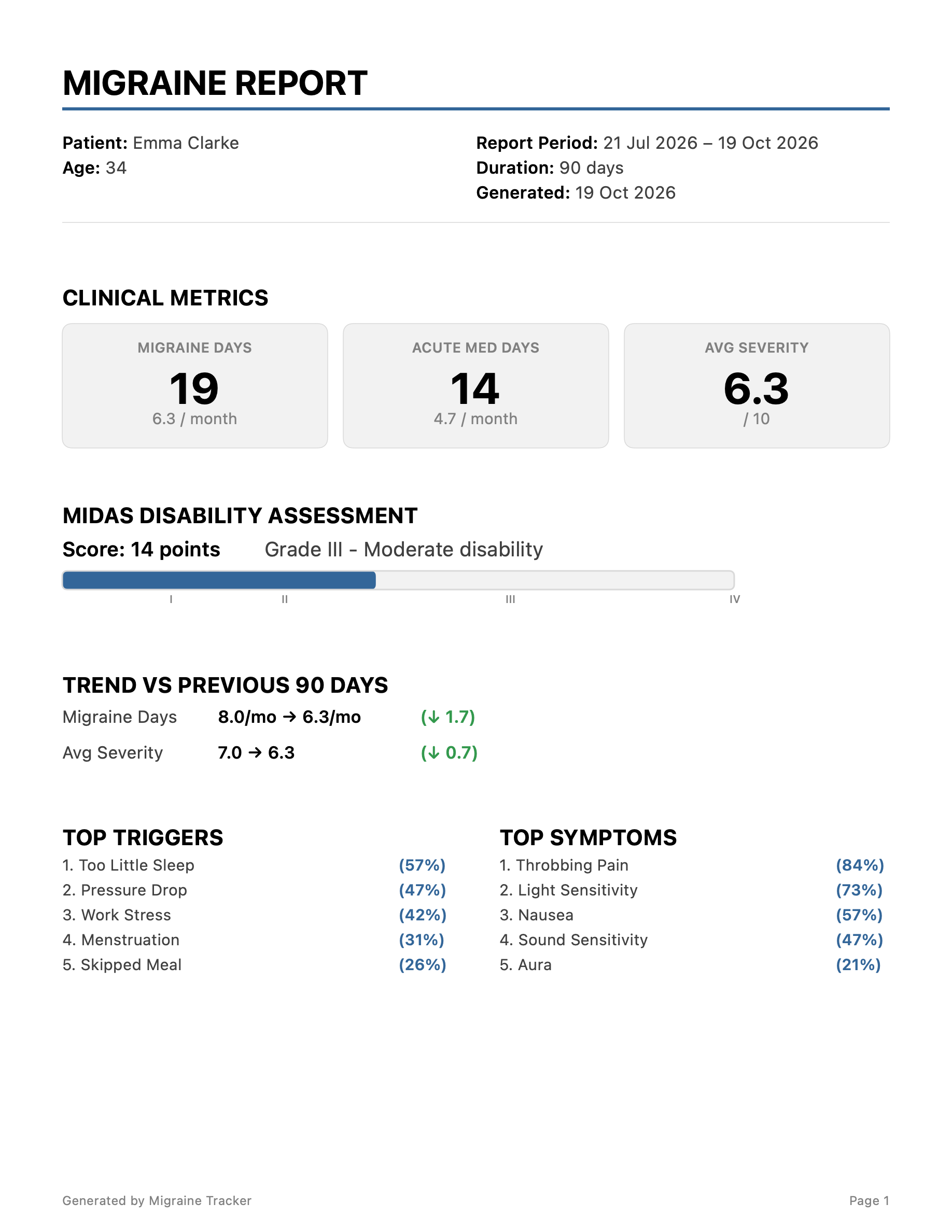
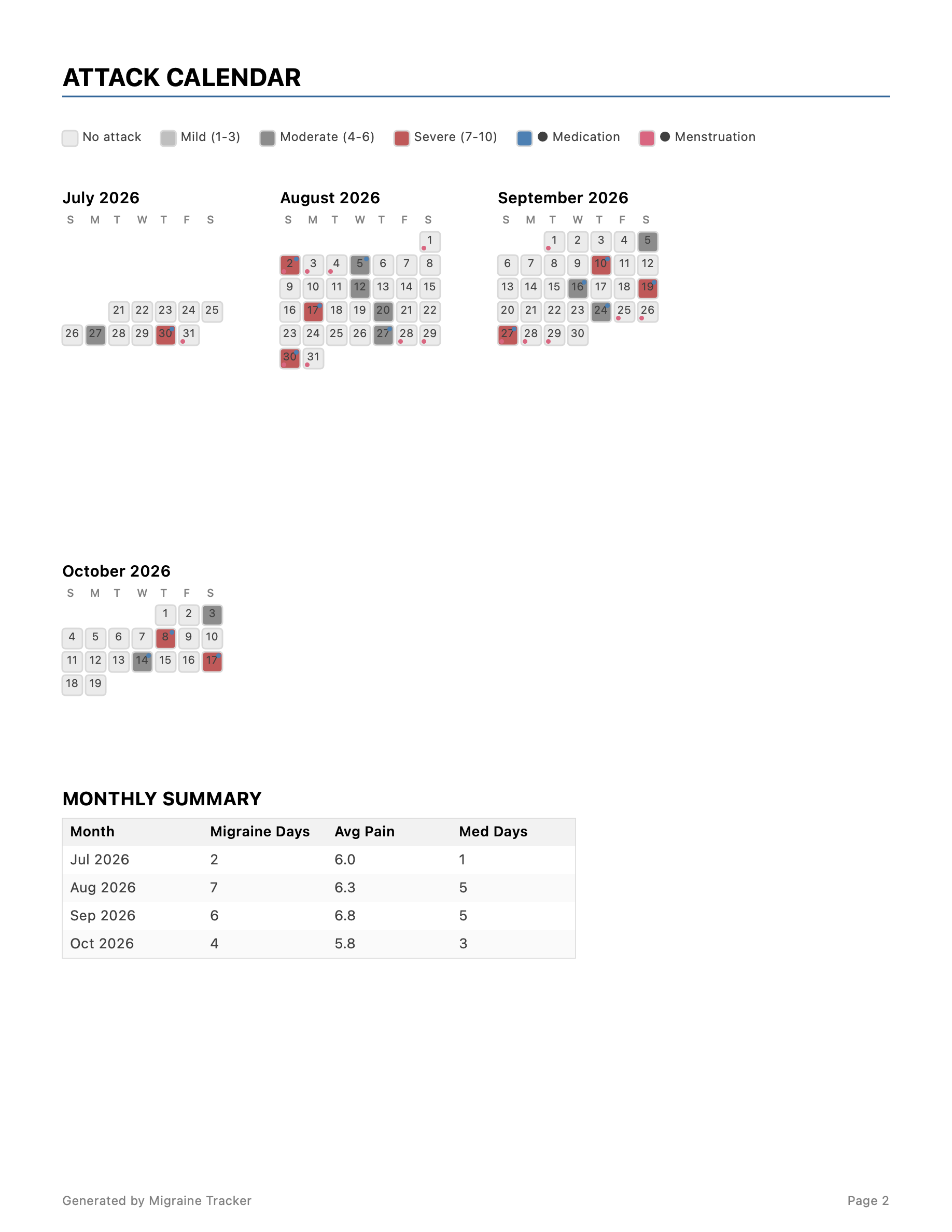
- PDF report (Premium). It covers the last 30 days, 90 days, 6 months or 1 year. Page 1 shows Migraine Days and Acute Med Days, in total and per month, and compares Migraine Days per month with the previous period of the same length. Page 2 has a calendar and a summary for each calendar month. The PDF report guide shows the steps.
- Migraine Days are start dates. An attack that lasts into a second day counts once, and the PDF has no hours per date. Count the extra dates and hours from the attacks’ start and end times.
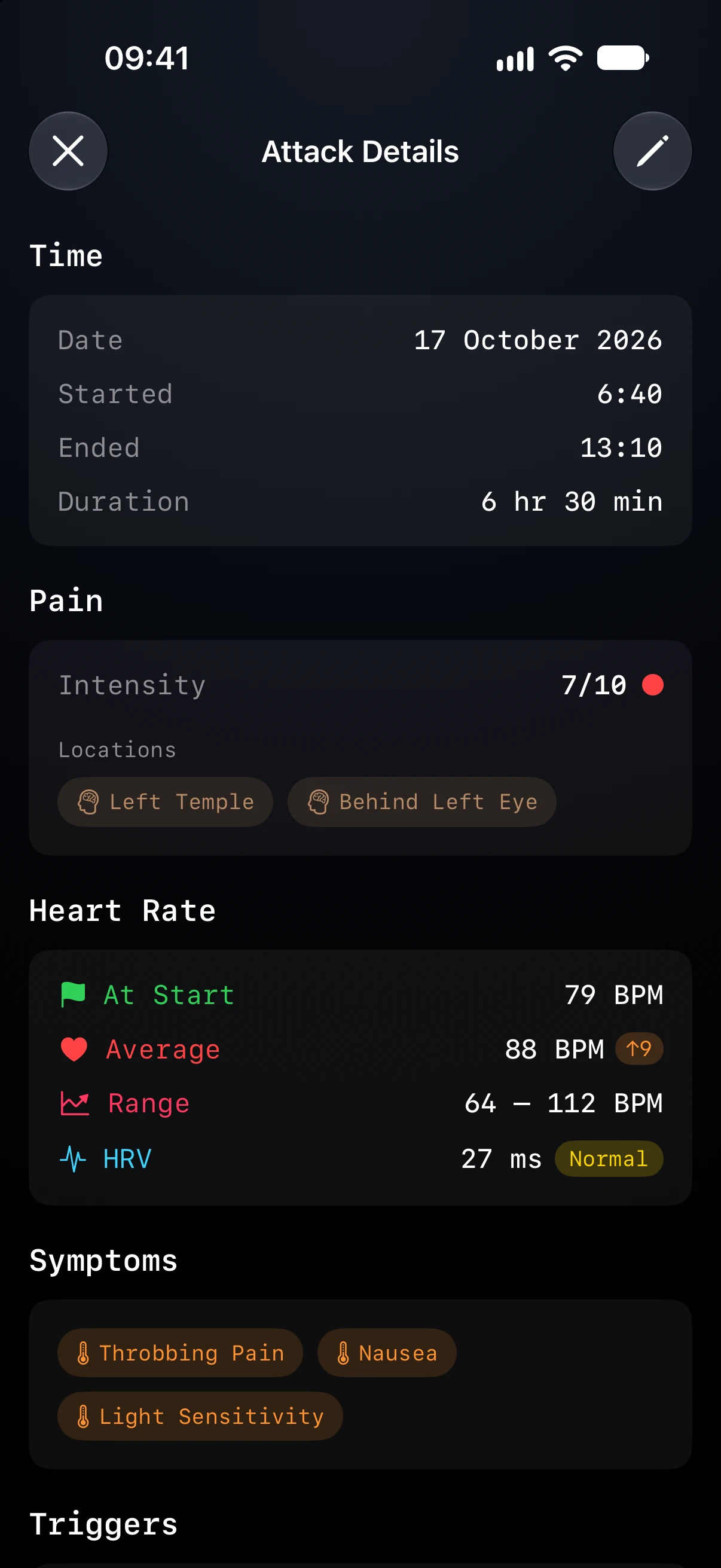
- Start and end times. Each attack’s details show when it started and ended and how long it lasted. With Premium, a CSV export lists the start date, start and end times and duration of every attack, which you can count in a spreadsheet.
- MIDAS (Premium). The app’s MIDAS questionnaire asks about the last 3 months, and the app offers a new one only once the last is 3 calendar months old. Rounds are 12 weeks apart, so ask the clinic for a score at each visit. The PDF shows the most recent score without its date, so note the date yourself.
- Preventive medicines. Botox and the CGRP antibodies erenumab, galcanezumab and fremanezumab are in the app’s medicine list as preventives. But medicines are recorded with an attack, and the PDF does not list medicine names, so the app does not keep a record of when a preventive started or stopped. Keep the list above separately.
- Migraine or other headache. The app has no separate field for this. Symptoms and notes help your clinician judge which days had migraine features.
When to talk to someone
- If you have had Botox and have trouble breathing, speaking or swallowing, get medical help straight away: in the US, call 911. The label warns that these effects can appear hours to weeks after an injection.
- Never change, skip or stop a medicine, or its dose, to meet a plan’s rule. Ask your prescriber first.
- If you take painkillers or triptans on many days a month, talk to your clinician, because frequent use can cause medication overuse headache.
- The NHS says to “ask for an urgent GP appointment or get help from NHS 111” if you have a migraine attack and “it’s lasted longer than 72 hours”. In the US, contact your clinician or an urgent care service.
- The NHS says to call 999 if you “have a headache that came on suddenly and is extremely painful”. In the US, call 911. Elsewhere, call your local emergency number.
Information from the NHS website, as at 191026: Migraine.
Sources
- DailyMed: BOTOX (onabotulinumtoxinA) prescribing information, revised November 2023
- CMS: Local Coverage Determination L39832, Botulinum Toxin Injections, Wellpoint Federal, effective 22 February 2026
- CMS: Medicare Coverage Database, to find the LCD for your state
- American Headache Society: Updated botulinum toxin A local coverage determination policy, 2026
- Aetna: Clinical Policy Bulletin 0113, Botulinum Toxin, last reviewed 14 July 2026
- UnitedHealthcare: Botulinum Toxins A and B, commercial medical benefit drug policy 2026D0017AN, effective 1 January 2026
- Cigna: Drug coverage policy IP0503, Aimovig, effective 1 June 2026
- Charles et al. Calcitonin gene-related peptide-targeting therapies are a first-line option for the prevention of migraine: an American Headache Society position statement update. Headache, 2024
- ClinicalTrials.gov: NCT00156910, the first Botox chronic migraine trial (PREEMPT 1), with the headache-day definition
- ClinicalTrials.gov: NCT00168428, the second Botox chronic migraine trial (PREEMPT 2)
- International Headache Society, ICHD-3: 1.3 Chronic migraine
- NHS: Migraine, reviewed 10 March 2026
Sources checked on 19 October 2026. The worked example and the screens use fictional demonstration data.
Coverage rules checked against the FDA label, Medicare local coverage determinations and the Aetna, UnitedHealthcare and Cigna policies on 19 October 2026. Plans change their rules, so check yours. App details checked against Migraine Tracker 1.1.0. The worked example and the screens use fictional demonstration data. This guide explains record keeping, not diagnosis, treatment or insurance advice. The sources explain general principles and do not endorse Migraine Tracker.