
Can daylight saving time trigger migraines? The evidence
Two small studies found more migraines after the spring clock change, and one found fewer after autumn. What that means, and how to check your diary.
The short answer
Only two studies have tested this directly. Both found more migraines after the clocks went forward in spring. The one that also looked at autumn found slightly fewer migraines a week after the clocks went back. Both are small, so they cannot tell you what the next change will do for you.
In 2026 the clocks go back on Sunday 25 October in the UK and the EU, and on Sunday 1 November in the US. Comparing the two weeks before and after the change in your own diary is the most direct way to see whether it affects you.
What the change does to sleep
Moving the clock by an hour shifts your sleep against your body clock. The American Academy of Sleep Medicine, which wants seasonal changes abolished in favour of permanent standard time, notes that “most acute health-related effects are noted only when transitioning from standard time to DST”, the spring change. It adds that “transitions both into and out of DST have been associated with sleep disruption”.
The spring change usually costs sleep. Using US time-use data, researchers found that on the Monday after it, “workers sleep on average 40 min less than on other days”. After the autumn change, they found “no significant differences in sleep”. A 2013 review found “little evidence of extra sleep” on the night the clocks go back, and suggested a “net loss of sleep across the week” that follows.
The two migraine studies
| Study and participants | What it found |
|---|---|
| Gorantla et al., 2026, US: 23 adults with episodic migraine, followed for 2 weeks before and 2 weeks after the spring change in March 2023, with a headache diary and an under-mattress sleep tracker | Migraines rose from 7.76 to 13.35 per 100 days of follow-up, roughly from 1 to 2 migraine days per person per fortnight. Total sleep stayed the same, at about 7 hours 18 minutes, but deep sleep fell from about 94 to 84 minutes a night. |
| Göbel et al., 2025, Germany: Headache diaries from 258 patients of one specialist headache centre, 2020 to 2022, mostly women with episodic migraine | A week after the spring change, the share of patients with a migraine on the Sunday or Monday rose from 34.4% to 40.8%. A week after the autumn change, it fell from 41.5% to 36.0%. The authors note that the effect “does not occur immediately on the weekend of the time change but with a delay of one week”. |
Both have clear limits. The first followed 23 people through one spring change, without a comparison group, and migraine was a secondary measure in a sleep study. The second looked back at records from one specialist centre, where nearly all patients were already on a preventive treatment, and counted only Sundays and Mondays.
Taken together, they point the same way as the sleep studies: the spring change seems harder than the autumn one. Neither shows that the autumn change makes migraine worse.
Why the evidence is thin
A 2026 systematic review of 157 studies on daylight saving time and health found just one on migraine, and concluded that “the evidence base remains limited and heterogeneous”. We found no studies of emergency visits for headache around the clock change, and none using diary app data.
Sleep changes are among the triggers people name most often. In a meta-analysis of 85 studies with 27,122 participants, 41% of people with headache named sleep as a trigger. Naming a trigger is not the same as showing that it causes attacks, and the authors found “extreme heterogeneity” in the research.
Cluster headache is often linked to the clock change in news reports. A 2023 meta-analysis found that cluster headache tends to peak in spring and autumn, but we found no study that separates the clock change from the season.
Check your own diary
Your own records can tell you more about yourself than these studies can. Compare the two weeks before a change with the two weeks starting on the day of the change.
| UK and EU | US | |
|---|---|---|
| Clocks go back | Sunday 25 October | Sunday 1 November |
| The fortnight before | 11–24 October | 18–31 October |
| The fortnight after | 25 October – 7 November | 1–14 November |
- Count migraine days in each fortnight. Count each day with a migraine once, as you would for a monthly count.
- Look a week later too. The German study found its change a week after the clocks moved, not on the weekend itself.
- Note your sleep for a few nights either side. When you went to bed, when you woke up and how you slept.
- Expect noise. If you have 4 migraine days a month, you would expect about 2 in any fortnight. Chance alone puts 3 or more in about 28% of fortnights, and 5 or more in about 4%.
- Repeat over several changes, in spring and autumn. One bad fortnight is not a pattern. If the fortnight after is worse change after change, mention it to your clinician. Even then, a pattern in a diary is a starting point, not proof of a cause.
The chance figures are Poisson probabilities, assuming 4 migraine days a month that occur at random. They show how easily a bad fortnight appears by chance. They are not a test of your own diary.
What Migraine Tracker records
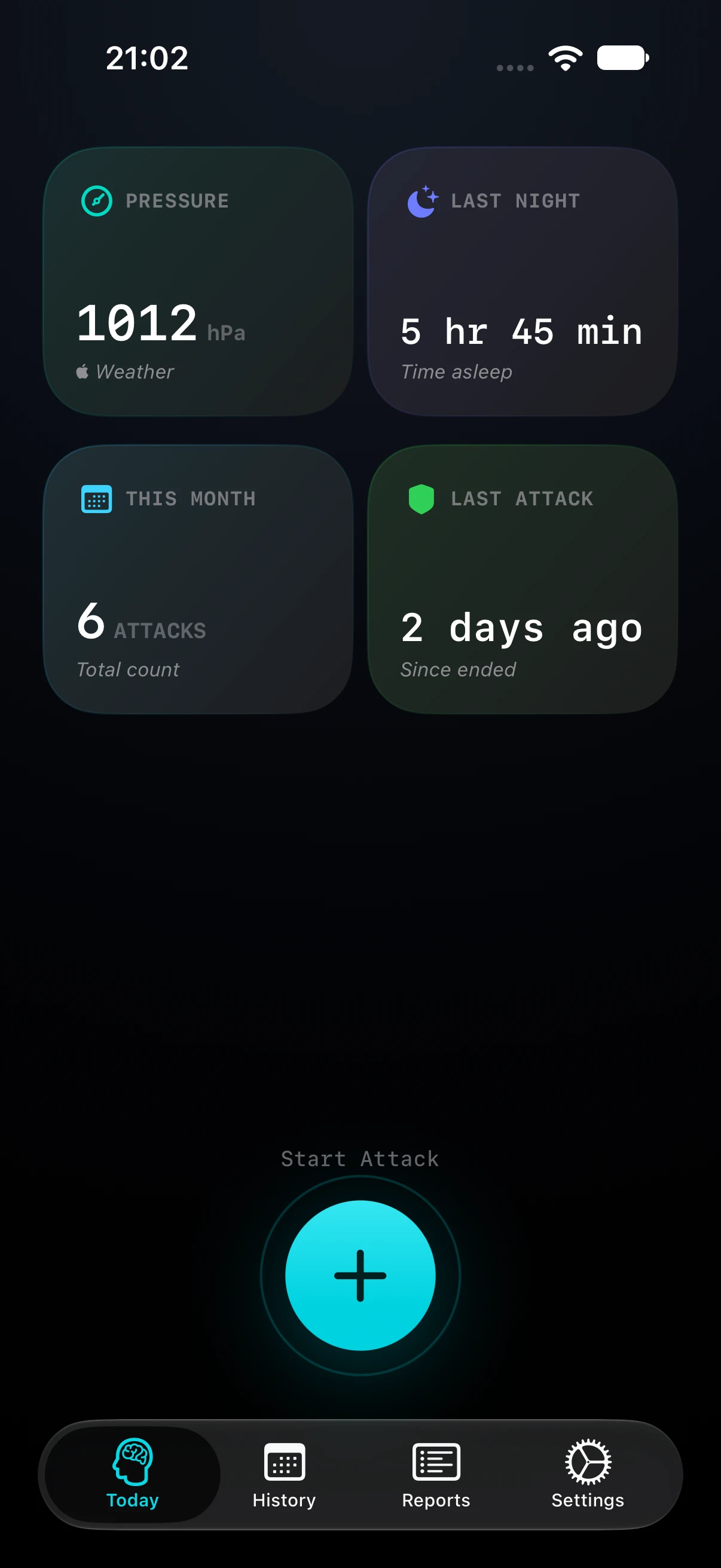
- Last night’s sleep with each attack. When you start an attack in the app, on Apple Watch or with Siri, Migraine Tracker saves how long you slept the night before from Apple Health, if you have allowed access and sleep data is available. Attacks you add later have no sleep reading.
- Sleep triggers. Too Little Sleep, Too Much Sleep, Irregular Schedule and Poor Sleep Quality are in the built-in trigger list. A trigger records what you suspected, not what caused the attack.
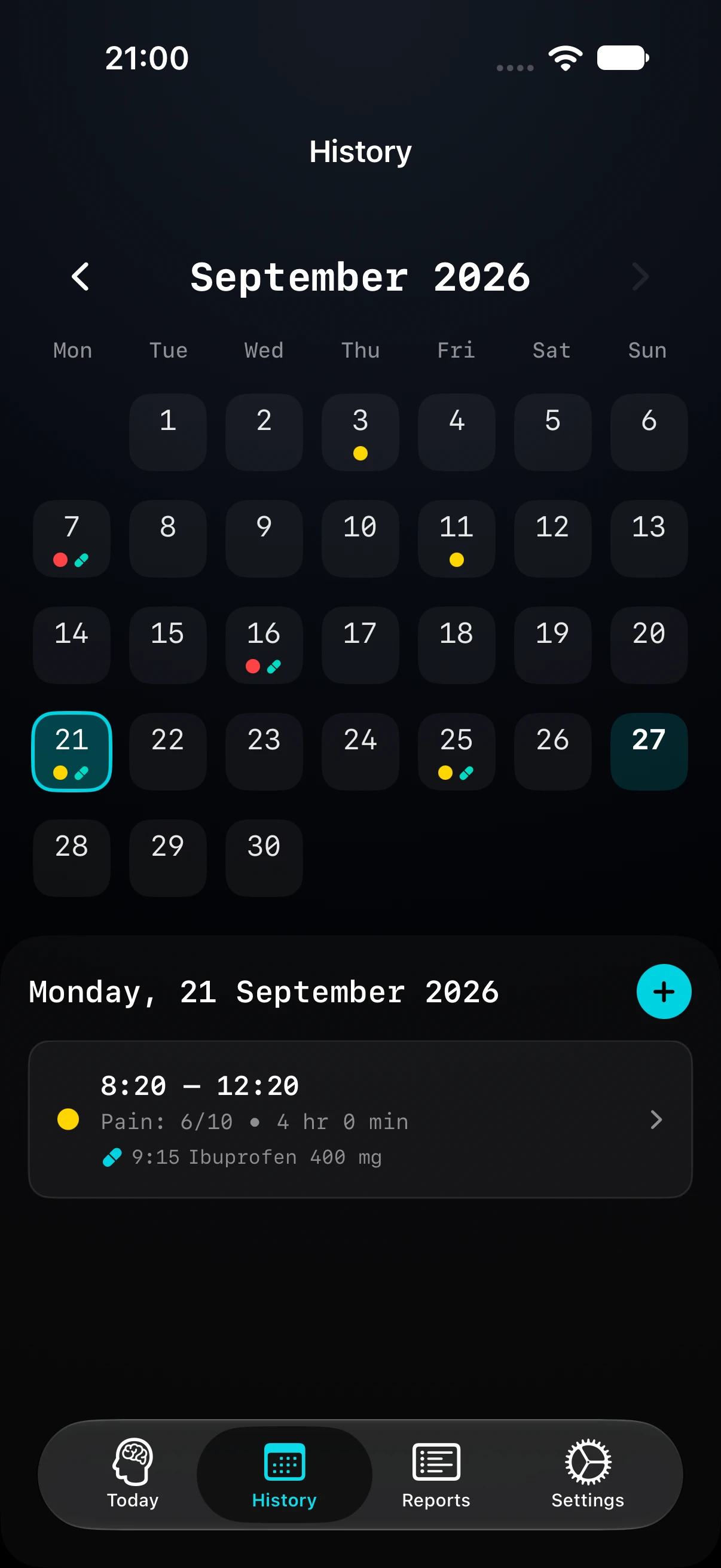
- Counting fortnights. History shows each attack on the day it started, so you can count each fortnight directly. Reports cover the last 7 days, or 30 and 90 days with Premium, so they do not line up with the clock change.
- Notes. Use the note to record bedtimes or a disrupted night around the change.
When to talk to someone
- The NHS says to see a GP if “your migraine attacks are severe or getting worse, or lasting longer than usual” or if “you have migraine attacks more than once a week”.
- If you are thinking about sleep aids or changes to your medicine around the clock change, talk to your GP or pharmacist first.
- The NHS says to call 999 if you “have a headache that came on suddenly and is extremely painful”. Elsewhere, call your local emergency number.
Information from the NHS website, as at 191026: Migraine.
Sources
- Gorantla et al. The effect of standard time to daylight-saving clock transition on sleep and migraine headaches. Journal of Clinical Sleep Medicine, 2026
- Göbel et al. The impact of biseasonal time changes on migraine. Neurology International, 2025
- Steponenaite et al. A systematic review of epidemiological studies into daylight-saving time and health identifying beneficial and adverse effects. European Journal of Epidemiology, 2026
- Rishi et al. Daylight saving time: an American Academy of Sleep Medicine position statement. Journal of Clinical Sleep Medicine, 2020
- Barnes and Wagner. Changing to daylight saving time cuts into sleep and increases workplace injuries. Journal of Applied Psychology, 2009
- Harrison. The impact of daylight saving time on sleep and related behaviours. Sleep Medicine Reviews, 2013
- Pellegrino et al. Perceived triggers of primary headache disorders: a meta-analysis. Cephalalgia, 2018
- Benkli et al. Circadian features of cluster headache and migraine: a systematic review, meta-analysis, and genetic analysis. Neurology, 2023
- GOV.UK: When do the clocks change?
- NIST: Daylight saving time
- NHS: Migraine
Sources checked on 14 October 2026. App screens use fictional demonstration data.
App details checked against Migraine Tracker 1.0.9 on 14 October 2026. App screens use fictional demonstration data. This post explains research and record keeping, not medical advice. The sources explain general principles and do not endorse Migraine Tracker.